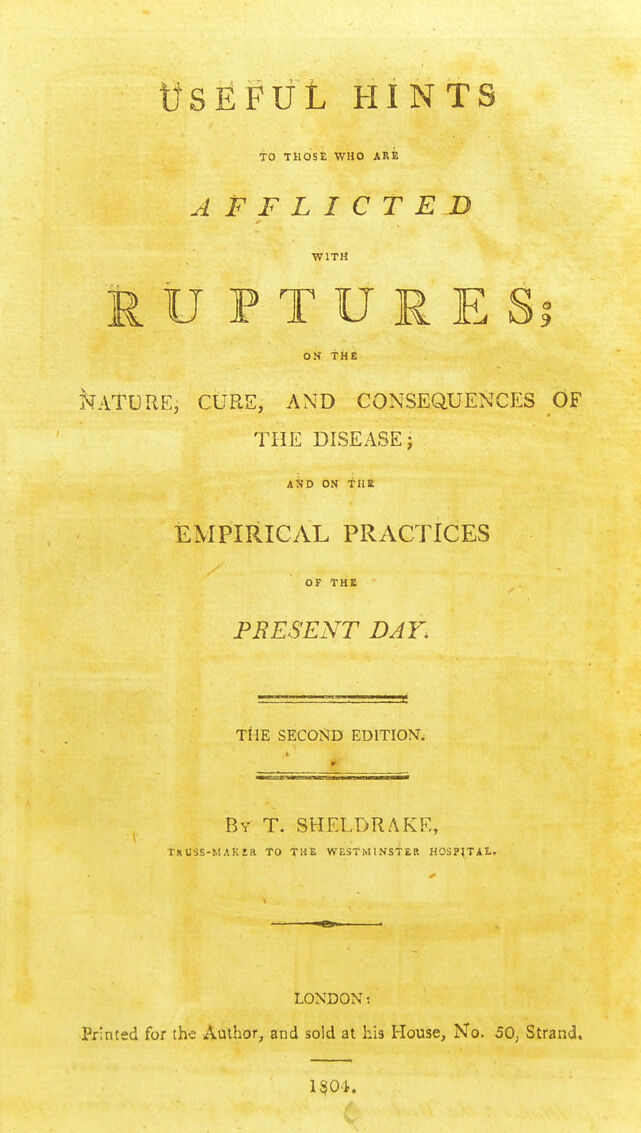
Useful hints to those who are afflicted with ruptures : on the nature, cure, and consequences of the disease ; and on the empirical practices of the present day / by T. Sheldrake.
- Sheldrake, Timothy, active 1783-1806
- Date:
- 1804
Licence: Public Domain Mark
Credit: Useful hints to those who are afflicted with ruptures : on the nature, cure, and consequences of the disease ; and on the empirical practices of the present day / by T. Sheldrake. Source: Wellcome Collection.
Provider: This material has been provided by The University of Glasgow Library. The original may be consulted at The University of Glasgow Library.
62/198 page 34
![an inconvenience which has been much complained of *' by those who have been under a necesiity of wearing *' these bandages. Here then, we have Mr. Turnbull particular!}' de- scribing, and taking credit to himself for bringing into })ra,ctice that particular method of constructing trusses, Avhich W. H. T. Esq. says, was the mud viethod, for no one reason in the world, but from an old custom, and W, H. T. Esq. in return demonstrates, in the most satisfactory man- ner, that Mr. Turnbull's boasted improvement is the most absurd, most dangerous, and most ineffectual method that can be adopted, and what is not a httle paradoxical, they both arc in the right, and each of them is wrong. It is singular that Mr. Turnbull should demonstrate any fact, particularly one that will so little increase his re- putation as a director of mechanics, for it is not supposed that which our historian does not seem to have understood, as he employs several pages in explaining the terms drawing and accepting bills, cross acceptances, &c. but the v^^hcile seems to amount to what has since, in England, been called, bills of accommodation ; many of these were ma- nufactured, and becoming due before the money was forth coming, the doctor threw them all upon his deputy, and left hira to settle them as he could. This one, being unable to pay, thought to get indemnified by complaining of his associate, and exposing him to the society, which he attempted to do in a full assembly, but the doctor had many friends there who got a majority to determine, that the society would not inter- fere in the pri'vate transactions of its officers; they expelled the deputy for improper behaviour in prefering his complaint, and voted that a ]argc sum of rnoney should be given to the doctor out of the funds of the charity, as a grateful return for the manifold services he had ren- dered it. This disgusted the honourable part of the members, who im- mediately renounced the society, and as rto persons of respectability would atterwards be connected with those who remained, it sunk, after some struggles, into oblivion ; and thus, by the conduct of a few unprin- pipled men, was an establishment, which at its outset promised to be as useful as any in Lilliput, totally destroyed, and the suffering poor deprived of that assistance which the benevolence of their richer neigh- bours would v/illingly have afforded them. To return from this long digression to Mr. Turnbull; when the secrets of his conscience shall be laid open, it will be known luhy those gentlemen whom he beplaistered with so much praise withdrew them- selves from the society tor relieving the ruptured poor, which they had been so willing tu Siupport, and which they had the power to serve ; and why,'since those gentlemen did leave it, no name of more consequence than that of Mr. Turnbull has been found to put at the head of ths ppncem. Till he does explain all this, the transaction, in all its parts, may form one of the most flattering distinctions of his life, and yet not be tl-.at kind of distinction wWch every man will envy hira.](https://iiif.wellcomecollection.org/image/b21467493_0062.jp2/full/800%2C/0/default.jpg)