Volume 1
The tobacco industry and the health risks of smoking : second report / Health Committee.
- Great Britain. Parliament. House of Commons. Health Committee
- Date:
- 2000
Licence: Open Government Licence
Credit: The tobacco industry and the health risks of smoking : second report / Health Committee. Source: Wellcome Collection.
82/92 page 80
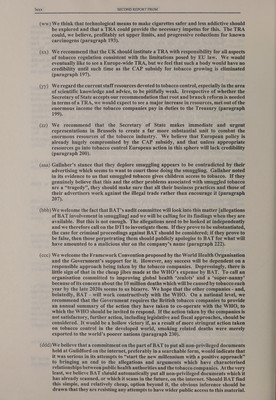
![(ww) We think that technological means to make cigarettes safer and less addictive should be explored and that a TRA could provide the necessary impetus for this. The TRA could, we believe, profitably set upper limits, and progressive reductions for known carcinogens (paragraph 193). (xx) We recommend that the UK should institute a TRA with responsibility for all aspects of tobacco regulation consistent with the limitations posed by EU law. We would eventually like to see a Europe-wide TRA, but we feel that such a body would have no credibility until such time as the CAP subsidy for tobacco growing is eliminated (paragraph 197). (yy) Weregard the current staff resources devoted to tobacco control, especially in the area of scientific knowledge and advice, to be pitifully weak. Irrespective of whether the Secretary of State accepts our recommendation that root and branch reform is needed in terms of a TRA, we would expect to see a major increase in resources, met out of the enormous income the tobacco companies pay in duties to the Treasury (paragraph 199). (zz) We recommend that the Secretary of State makes immediate and urgent representations in Brussels to create a far more substantial unit to combat the enormous resources of the tobacco industry. We believe that European policy is already hugely compromised by the CAP subsidy, and that unless appropriate resources go into tobacco control European action in this sphere will lack credibility (paragraph 200). (aaa) Gallaher’s stance that they deplore smuggling appears to be contradicted by their advertising which seems to want to court those doing the smuggling. Gallaher noted in its evidence to us that smuggled tobacco gives children access to tobacco. If they genuinely believe that this and the other problems associated with smuggled tobacco are a “tragedy”, they should make sure that all their business practices and those of their advertisers work against the illegal trade rather than encourage it (paragraph 207). (bbb) We welcome the fact that BAT’s audit committee will look into this matter [allegations of BAT involvement in smuggling] and we will be calling for its findings when they are available. But this is not enough. The allegations need to be looked at independently and we therefore call on the DTI to investigate them. If they prove to be substantiated, the case for criminal proceedings against BAT should be considered; if they prove to be false, then those perpetrating them should publicly apologise to BAT for what will have amounted to a malicious slur on the company’s name (paragraph 222). (ccc) We welcome the Framework Convention proposed by the World Health Organisation and the Government’s support for it. However, any success will be dependent on a responsible approach being taken by the tobacco companies. Depressingly, there is little sign of that in the cheap jibes made at the WHO’s expense by BAT. To call an organisation committed to improving global health ‘zealots’ and a ‘super-nanny’ because of its concern about the 10 million deaths which will be caused by tobacco each year by the late 2020s seems to us bizarre. We hope that the other companies - and, belatedly, BAT - will work constructively with the WHO. On a national level, we recommend that the Government requires the British tobacco companies to provide an annual summary of the action they have taken to co-operate with the WHO, to which the WHO should be invited to respond. If the action taken by the companies is not satisfactory, further action, including legislative and fiscal approaches, should be considered. It would be a hollow victory if, as a result of more stringent action taken on tobacco control in the developed world, smoking related deaths were merely exported to the world’s poorer nations (paragraph 230). (ddd) We believe that a commitment on the part of BAT to put all non-privileged documents held at Guildford on the internet, preferably in a searchable form, would indicate that it was serious in its attempts to “start the new millennium with a positive approach” to bringing an end to the allegations and arguments which have characterised relationships between public health authorities and the tobacco companies. At the very least, we believe BAT should automatically put all non-privileged documents which it has already scanned, or which it scans in the future, on the internet. Should BAT find this simple, and relatively cheap, option beyond it, the obvious inference should be drawn that they are resisting any attempts to have wider public access to this material. = oe a ee](https://iiif.wellcomecollection.org/image/b32221083_0001_0082.jp2/full/800%2C/0/default.jpg)