Auricular fibrillation and its relationship to clinical irregularity of the heart / by Thomas Lewis.
- Thomas Lewis
- Date:
- [1910?]
Licence: In copyright
Credit: Auricular fibrillation and its relationship to clinical irregularity of the heart / by Thomas Lewis. Source: Wellcome Collection.
29/80 (page 331)
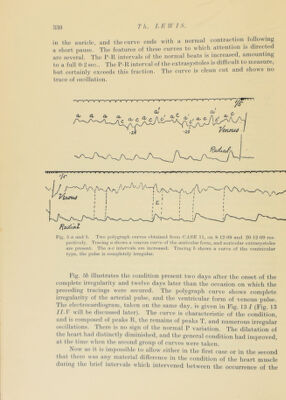
![normal and abnormal types of curve, for in both patients the cardiac affection was essentially a chronic one, so it is equally inqmssible to agree that the oscillations dis])layed were directly dependent upon myoeardial ehange. On the other hand the eases jirovide very suggestive evidence that we are dealing with a temporary inco-ordinate action of a limited jmrtion of the heart muscle ; and as the evidence of normal activity in the auricle is absent it is essentially towards that chamber that our attention should direct itself. The cases demonstrate conclusively the interdependence of the abnormal type of heart curve and the gross irregularity. Further, they afford a strong argument against the view adopted by Hering’” that the oscillations have their origin in the somatic musculature. The normal and abnormal curves were obtained under precisely similar conditions. It is perfectly true that many electrocardiograms show traces of variations produced by contraction of the muscles of the body wall or limbs, and at times it may be difficult to exclude this complication from the curves. But the oscillations of which we are speaking ])ear no relationshij) to the extent of such movements. Muscular movements give rise to irregularities in the curves when a jiatient trembles or fidgets. In the great majority^ of such cases these extraneous vibrations can be identified at once by their general appearance and rate. If precautions are taken in the avoidance of elderly or tremulous subjects, if the recumbent posture is adopted, and if in a warm room absolute stillness is enjoined and enforced, no such irregularities appear in subjects in which the heart sequence is normal. Oscillations are invariably present in the class of patient considered, whatever the precau- tions employed. They are of much the same degree from day to day and from hour to hour in the same subject. They are equally prominent when leads from the two arms are adopted, but vanish almost completely if the electrodes are attached to the two inferior extremities. The proposition, that they are part and parcel of the heart beat as it is represented to us electrocardiographically, is unequivocal. Very numerous and special leads have been devised and employed for the exclusion of their origin in abdomen, limbs and head and neck. The special leads show that it is a matter of indifference, so far as the amplitude of the oscillations is concerned, as to how great is the extent of somatic musculature which lies beneath and between the electrodes. They demonstrate that the excursion is controlled by the proximity of the heart to the leads. The special leads take us a step further, for they make it clear that it depends upon the part of the heart approached as to how conspicuously the oscillations will appear. The irregular oscillations arise in the vicinity of the auricle ; the ventricular electric complex in complete irregularity is of the normal form. Special electrodes were employed, composed of small circular copper plates, and these were fixed to the chest wall by means of a layer of stiff](https://iiif.wellcomecollection.org/image/b29000610_0029.jp2/full/800%2C/0/default.jpg)