Auricular fibrillation and its relationship to clinical irregularity of the heart / by Thomas Lewis.
- Thomas Lewis
- Date:
- [1910?]
Licence: In copyright
Credit: Auricular fibrillation and its relationship to clinical irregularity of the heart / by Thomas Lewis. Source: Wellcome Collection.
50/80 page 352
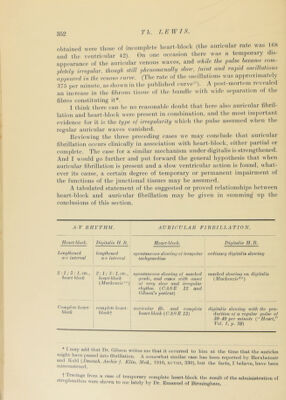
![obtained were those of ineoinplete heart-bloek (tlie anrienlar rate was 103 and the ventricular 42). On one occasion there was a temporary dis- ai^pearanee of the anrienlar venous waves, and while the pulse hecawe com- pletely irregular, though still phenomenally slow, faint and rapid oscillations appeared in the venous curve. (The rate of the oscillations was ai^])roxnnately 375 per minute, as shown in the ])nblished curve). A ])ost-mortem revealed an inerea.se in the (ibrons tissue of the bundle with wide separation of the fibres constituting it*. 1 think there can l)e no reasonable donbt that here also anrieidar fibril- lation and heart-block were ])resent in combination, and the most impoitant evidence for it is the type of irregularity which the pnlse assumed when the regular anrienlar waves vanished. Reviewing the three preceding eases we may eonclnde that anrienlar fibrillation occurs clinically in association with heart-block, either partial or complete. The case for a similar mechanism under digitalis is strengthened. And 1 would go further and put forward the general hypothesis that when auricular fibrillation is present and a slow ventricidar action is found, what- ever its cause, a certain degree of temporary or permanent impairment of the functions of the junctional tissues may be assumed. A tabulated statement of the suggested or proved relationships between heart-block and auricidar fibrillation may be given in summing up the conclusions of this section. A-V RHYTHM. AURICULAR FIBRILLATION. Heart- block. Digitalis H. B. Heart-block. Digitalis H. B. Lenrjthened a-c interval lengthened a-c interval spontaneou.s slowing of irregular tachycardias ordinary digitalis slowing 2 : 1 ; 3 : 1, etc., heart block 2:1; 3 :1. etc., heart-block (Mackenzie’'’’) spontaneous slowine; of marked grade, and cases with otuset of very .slow and irregular rhythm (CASE 12 and (Hhson's patient) marked slowing on digitalis (Mackenzie^^) Complete heart- block complete heart- block^ auricular fib. and complete heart-block (CASE 13) digitalis .slowing with the pro- duction of a regular pulse of 30-40 per minute (“Heart, Vol. I, p. 39) * I may add thatDr. Oi})a()n writes mo that it occurred to liim at the time that the auricles inig it ia\o jiassed into fibrillation. A somewhat similar case has been reported by Herxheimer and Ko\x\ (DeutKh. Archiv f. Klin. Med., 1910, xcviiT, 3.30), hut the facts, I helieve, have been misconstrued. t t racings from a case of temporary complete heart-block the result of the administration of strophantlms wore shown to me lately by Dr. Emanuel of Birmingham,](https://iiif.wellcomecollection.org/image/b29000610_0050.jp2/full/800%2C/0/default.jpg)