Auricular fibrillation and its relationship to clinical irregularity of the heart / by Thomas Lewis.
- Thomas Lewis
- Date:
- [1910?]
Licence: In copyright
Credit: Auricular fibrillation and its relationship to clinical irregularity of the heart / by Thomas Lewis. Source: Wellcome Collection.
58/80 page 360
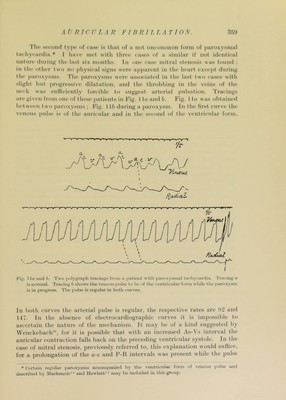
![way slow. In tliG patient from whom the figured, tiacings A\ere taken no impairment of conductivity was ever noticed and the increase of rate was not great. We may perhaps be dealing Avith ])aroxysms starting in the ventricle. The ])oint of importance at ])resent is the fact that interj)retations other than auricular fibrillation suggest themselves, and that while the pulse is fast, but regular, the latter may be rationally excluded. True “ nodal rhythm ” is a rare affection and gives riseto a clinical picture entirely at variance ivith that of the disorderly action of the heart hitherto considered. In the preceding pages it has been demonstrated that the condition w'hich has hitherto passed in this country under the name of “ nodal rhythm ” is in reality due to an inco-ordinate action of the auricle known to experimentalists as auricular fibrillation. In the discussion based on purely clinical data it was stated that it could be shown that auricle and ventricle are not contracting together. There are many reasons wdiich militate against the acceptance of the view of synchronous contraction of the two chambers in complete irregularity of the heart. These reasons I do not propose to consider, for they will readily suggest themselves as a result of the observations wdiich have been discussed. At the same time I desire to place on record, for purjioses of contrast, a single and fully con- sidered instance of wdiat I regard as a case approaching as nearly as possible to what may be termed, in the j)resent state of our knowledge, true nodal rhythm.* It will be shown that a rhytlim may be generated in the auricle near to or at its junction with the ventricle, and that the clinical ])icturc to wliicli it gives ri.se is strikingly at variance w ith that w hich is presented by com])lete irregularity of the heart. ddie folloAving case is the only om^ of its kind whiidi I have met with })ersoMally, and so far as I am aware only one ])atient showing signs of a similar though not identical nature has been so far recorded. The ease referred to is that r('])ort('d l)y Jlihl’' ; the descri])tion of the ease is meagre, but the venous curies sliow a eondition of ])aroxysmal tachyeardia and ap})ear to substantiate tiu' author’s conelusion that during the ])aroxysms auriide and ventricle contracted simultaneously. The eondition is therefore a very infre(]uent one. The ])atient, a report of whosi* eondition is now givcui, has been under continuous observation for maii}'^ months, and, of the numerous ob.servations wliieh liave been made upon him, attention will be c-hielly direeted to those which directly affect the general conclusions of the ])resent communic/ition. * I ho term atrio ventricular rhythm would perhaps be more consistent with our present knowlodpe ; for while we may state with a fair degree of ])rohahility that such rhythms originate ill tho junctional tissues, their accurate location in the node is not possible at the present time.](https://iiif.wellcomecollection.org/image/b29000610_0058.jp2/full/800%2C/0/default.jpg)