Auricular fibrillation and its relationship to clinical irregularity of the heart / by Thomas Lewis.
- Thomas Lewis
- Date:
- [1910?]
Licence: In copyright
Credit: Auricular fibrillation and its relationship to clinical irregularity of the heart / by Thomas Lewis. Source: Wellcome Collection.
59/80 page 361
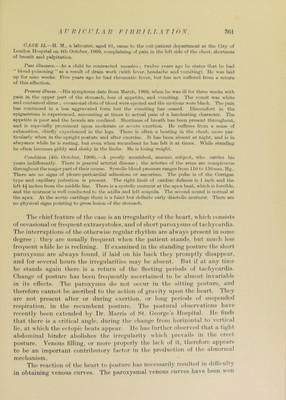
![CASE 15.—H. M., a labourer, aged 01, came to the out-patient dejiartment at the City of London Hospital on 4th October, 1909, coniplainiiig of pain in the left side of the cliost, shortness of breath and palpitation. Past illnesses.—As a child he contracted measles ; twelve years ago lie states that ho had “ hlood-])oisoning ” as a result of drain work (with fever, headache and vomiting). Ho was laid up for nine weeks. Five years ago he had rheumatic fever, but has not suflFerod from a return of this affection. Present illness.—His symptoms date from March, 1909, when he was ill for three weeks with pain in the u[)per j)art of the stomach, loss of appetite, and vomiting. The vomit was white and contained slime ; occasional clots of blood were ejected and the motions were black. The pain has continued in a less aggravated form but the vomiting has ceased. Discomfort in the epigastrium is experienced, amounting at times to actual ])ain of a lancinating character. The apj)etite is poor and the bowels are confined. Shortness of breath has been present throughout, and is especially prominent upon moderate or se\ero exertion. He sufferes from a sense <^f exhaustion, chiefly experienced in the logs. There is often a beating in the chest, more ])ar- ticularly when in the ui)right jK)sture and after exercise. It has been absent at night, and is in abeyance while he is resting, but even when recumbent ho has felt it at times. While standing ho often becomes guUly and shaky in the limbs. He is losing weight. Condition (4th October, 1909).—A poorly nourished, ana'inic sul)ject, who carries his years indifferently. There is general arterial disease ; the arteries of the arms are conspicuous throughout the major part of their c-ourse. Systolic blood-pressure ranges from 110 to 150 mnu Hg.. There are no signs of jfleuro-jiericardial adhesions or aneurism. The pulse is of the Corrigan type and ca])illary pulsation is present. The right limit of cardiac dulness is 1 inch and the left 4i inches from the middle line. There is a systolic murmur at the aix'x beat, which is forcible, and the murmur is well conducted to the axilla anil left scapula. The second souiul is normal at the afiex. At the aortic cartilage there is a faint but definite early diastolic murmur. There are no physical signs pointing to gross lesion of the stomach. The chief feature of the ease is an irregularity of tlie lieart, w liieh consists of occasional or frcfjuent extrasystoles, and of short paroxysms of tachycardia. The interrti])tions of the otherwise regular rhythm are always ])resent in some degree ; they are usually fre(|uent when the ])atient stands, hut much less frequent while he is reclining. If examined in the standing posture the short paroxysms are always found, if laid on his hack they ])rom])tly disappear, and for several hours the irregularities may he absent. Mut if at any time he stands again there is a return of the ileeting ])eriods of tachycardia. Change of posture has been fre({uently ascertained to he almost invariable in its effects. The ])aroxysms do not occur in the sitting posture, and therefore cannot he ascribed to the action of gravity u])on the heart. They arc not present after or during exertion, or long ])eriods of suspended res])iration, in the recumbent ])osture. The postural observations have recently been extended by ])r. Marris of St. CJeorge’s l[osj)ital. He finds that there is a critical angle, during the change from liorizontal to vautical lie, at which the ecto])ic beats a])])car. He has further obscrvc<l that a tight abdominal binder abolishes the irregularity which prevails in the cn'ct posture. Venous filling, or more })roperly the lack of it, therefore api)ears to be an im])ortant contributory factor in the production of the abnormal mechanism. The reaction of the heart to posture has necessarily resulted in difficulty in obtaining venous curves. The paroxysmal venous curves have been won](https://iiif.wellcomecollection.org/image/b29000610_0059.jp2/full/800%2C/0/default.jpg)