Auricular fibrillation and its relationship to clinical irregularity of the heart / by Thomas Lewis.
- Thomas Lewis
- Date:
- [1910?]
Licence: In copyright
Credit: Auricular fibrillation and its relationship to clinical irregularity of the heart / by Thomas Lewis. Source: Wellcome Collection.
60/80 page 362
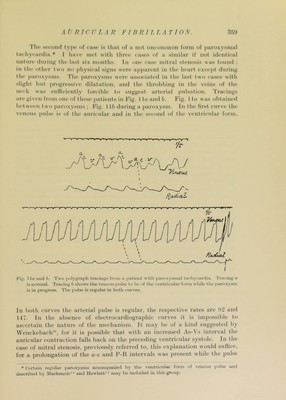
![.162 oil tlirt'c occcisioiis oiilv. It' luis cilso roiiclt^iod tlio siiiiultcinBOUiS rccoifl of venous and electrocarciiograpliic curves impossible ; tlie electrocardiograms \\ere taken with the patient standing. The jiaroxysms and single inter- rii|)tions are immediati'ly ri'cognised by the patient when they occni. d’he pulse, when regular between the jiaroxysms, is usually slow, its rate varies between .‘{7* and 70 per minute. At times there is a certain degree of sinus arrhythmia. The extra or eetojiie beats which interrupt the normal rhythm are of varied form, but most of them conform to the recognised pictures of auricular and “ nodal ” extrasystoles, w hen examined in the venous curves. The electrocardiogra])hic tracings show at least tour varieties, but as their nature is not entirely clear further reference to them will be postponed. More frequently than otherwise they differ from the beats of the paroxysm itself. In this respect they resemble the single interruptions met wdth in other cases of paroxysmal tachycardia. The paroxysms consist of a series of regularly jilaced beats (there is some general diminution of rate as the individual attack proceeds), and the rate lies between 135 and 160 per minute. Alternation is very frequent, and in simultaneous electrocardiographic and radial curves the small beat in one may correspond to the large beat in the other, or vice versa. The onset of the tachycardia is marked by the occurrence of several anomalous beats wdiich do not properly belong to it. In the radial curves (Figs. 27-28) they are differentiated by the low level which they occupy in the curve, and by their relative insignificance. Venous curves (Fig. 27, second paroxysm) may point to their having a higher originf than the beats of the paroxysm proper. The high level of origin is also borne out b}^ the electrocardiographic curves (Fig. 26), as will be seen later. The contractions of the heart during the ])aroxysm proper yield venous curves wdiich consist of high ])eaked waves, similar to those seen when auricle and ventricle are known to contract together (e.g., in comjilete heart-block and in cases of single ventricular extrasystole). The points at which a and c are estimated as due do not fall absolutely together, but they are nearer together than is the case with certain of the premonitory beats. The length of the interval is generally 0-06 sec., the a-c interval of the normal rhythm is 0-2 sec.. (The ])resphygmic interval for normal and jiaroxysmal beats is the same on the arterial side). The venous curves definitely indicate that auricle and ventricle are in simultaneous contraction. Yet the auricular contraction commences at a slightly earlier time than does that of the ventricle. The interval is too short to ))ermit of the conclusion that ventricle is res])onding to auricle, but, on the contrary, it may be su])posed that the two chambei’s arc contracting in response to a common source of impulse toimation. It may be argued, from the evidence, that this common focus lies nearer to the auricle than to the ventricle. In other words, the * 'I'liis low raU) occorrod during sinus arrhyUiinia. Tho usual rak) is 50-54. i The higher the origin the greater is the a-c interval.](https://iiif.wellcomecollection.org/image/b29000610_0060.jp2/full/800%2C/0/default.jpg)