Auricular fibrillation and its relationship to clinical irregularity of the heart / by Thomas Lewis.
- Thomas Lewis
- Date:
- [1910?]
Licence: In copyright
Credit: Auricular fibrillation and its relationship to clinical irregularity of the heart / by Thomas Lewis. Source: Wellcome Collection.
77/80 page 379
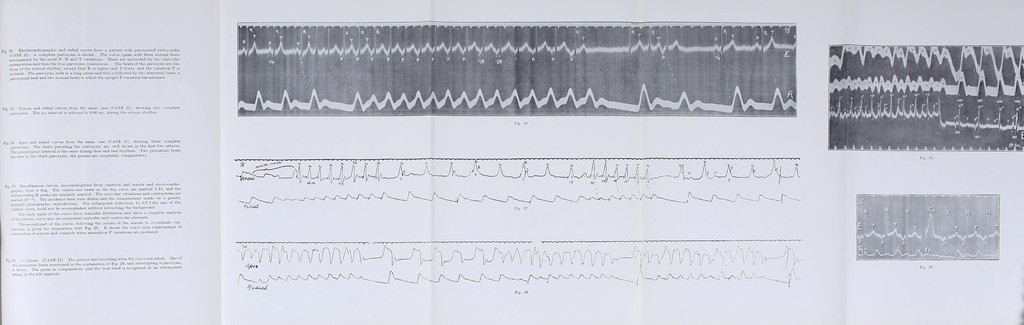
![Fig. .il. A series t)f exjic'rimenlrtl curves from a single animal. Cuuvio r. Lo'acl.s from a j^niiit on the auricle just below the superior \'ena ca\a and from the inferior vena cava. The auricle was fibrillating u[> to the i)lace marked by an arrow. At this point the co-ordinate I'ontractions returned. A = auricular variations. V = ventricular variations. Curve II. A similar curve. The point where auricular fibrillation ceases is uncertain. In both curves the oscillations are maximal. Curve III. Leads from two jioints on the right ventricle, one above and near the right border, and one below and nel^r the apex. The auricle is fibrillating over the wliole curve, yet no oscillations are seen. to the iioint where the arrow is placed the vagus was stimulated and a slight escape of current is shown in the curve. Curve I V. From the same points after the return to the normal rhythm. A comparison with the last curve show's that the direction of contraction in the ventricle is identical wiiile auricular fibrillation and auricular co-ordination are ])resent. Curves III and I V maybe compared in respect of the amplitude of the opening varia- tions of the separate beats. In 171 it is variable, in 7 V it is constant. Therefore the auricular oscillations are not entirely responsible for the \'ariation in the height of the peaks R during fibrillation, for in III no oscillations are present. The height of the opening variations is greater in 777 than in 7 V. Curve V. Leads from the ujijier and low'er ends of the w'ound. The wound travelled through the centre and w'hole length of the stern\un. The upj)er electrode w'as upon the base of the neck, the low’er one upon the diapliragm. Tlie curve is very small and though much somatic musculature w'as included botw'een the electrodes, no oscillations are seen. As a consequence, the oscillations are showm to arise in the heart itself. At the arrow the normal rhythm is resumed. X^p to this point the sensitivity of the galvanometer was maintained at a constant point. Curve F7. The same leads as the last, but the sensitivity of the galvanometer is now' increased approximately threefold. The oscillations are just visible and distort the curve to some extent. The normal rhythm is resumed w'here the arrow' is placed. A careful comparison of the ventricular cm'ves before and after the resumihion of the normal rhythm show's them to be of essentially the same form, and this form is the normal one. The electrode site first mentioned is invariably the site of the base electrode. Fig. 31.](https://iiif.wellcomecollection.org/image/b29000610_0077.jp2/full/800%2C/0/default.jpg)