Neuro-dynamic medicine ; Neuro-therapeia / by E. Haughton, M.D.
- Haughton, E. (Edward)
- Date:
- [1866-67]
Licence: Public Domain Mark
Credit: Neuro-dynamic medicine ; Neuro-therapeia / by E. Haughton, M.D. Source: Wellcome Collection.
Provider: This material has been provided by The University of Glasgow Library. The original may be consulted at The University of Glasgow Library.
3/8
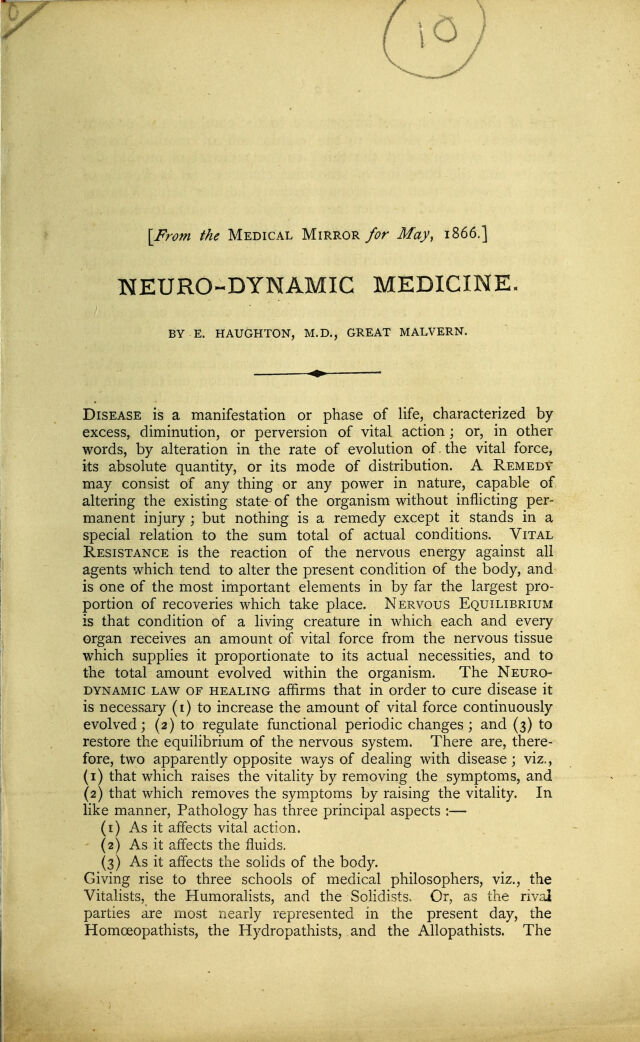
![[From the Medical Mirror for May, 1866.] NEURO-DYNAMIC MEDICINE. BY E. HAUGHTON, M.D., GREAT MALVERN. Disease is a manifestation or phase of life, characterized by excess, diminution, or perversion of vital action; or, in other words, by alteration in the rate of evolution of . the vital force, its absolute quantity, or its mode of distribution. A Remedy may consist of any thing or any power in nature, capable of altering the existing state of the organism without inflicting per- manent injury; but nothing is a remedy except it stands in a special relation to the sum total of actual conditions. Vital Resistance is the reaction of the nervous energy against all agents which tend to alter the present condition of the body, and is one of the most important elements in by far the largest pro- portion of recoveries which take place. Nervous Equilibrium is that condition of a living creature in which each and every organ receives an amount of vital force from the nervous tissue which supphes it proportionate to its actual necessities, and to the total amount evolved within the organism. The Neuro dynamic law of healing affirms that in order to cure disease it is necessary (i) to increase the amount of vital force continuously evolved; (2) to regulate functional periodic changes; and (3) to restore the equilibrium of the nervous system. There are, there- fore, two apparently opposite ways of dealing with disease; viz., (1) that which raises the vitality by removing the symptoms, and (2) that which removes the symptoms by raising the vitality. In like manner, Pathology has three principal aspects :— (i) As it affects vital action. - (2) As it affects the fluids. (3) As it affects the solids of the body. Giving rise to three schools of medical philosophers, viz., the Vitalists, the Humoralists, and the Sohdists. Or, as the rival parties are most nearly represented in the present day, the Homoeopathists, the Hydropathists, and the Allopathists. The](https://iiif.wellcomecollection.org/image/b21481957_0003.jp2/full/800%2C/0/default.jpg)