Content advisory
This digitised material is free to access, but contains information or visuals that may:
- include personal details of living individuals
- be upsetting or distressing
- be explicit or graphic
- include objects and images of objects decontextualised in a way that is offensive to the originating culture.
"Ribonuclease II. Accuracy of measurement and shrinkage."
- Date:
- 1954-1955
- Reference:
- PP/CRI/H/1/32
Licence: In copyright
Credit: "Ribonuclease II. Accuracy of measurement and shrinkage.". Source: Wellcome Collection.
3/25
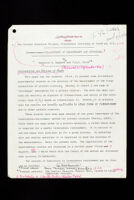
![, V/ ' J v/ 1 !\ <sxsx is. 1 { ¡ x ^ 1 : The Protein Structure Project, Polytechnic Institute of Brooklyn, N.Y. } 0. 3.A Ri bonuc lease» 11 je. ACCURACY OF MEASUREMENT AND SHRINKAGE. ß y* Introduction and Outline of /a It tvwiw /«fj This paper has two objects: /First, to present some preliminary experimental studies on the accuracy of the measurement of the X-ray intensities of protein crystals^ fécond, to report a new type of 'shrinkage' phenomenon for a protein crystal. The work has been car ried out entirely on crystals of ribonuclease, and mainly on the mono- clinic form (P 2j) known as ribonuclease II. However^it is probable that the results are broadly applicable to other forms of ribonuclease and to other protein crystals. These studies have been made because of the great importance of the isomorphous-replacement method for protein crystals (Perutz, 1954). Since there are many atoms in a protein molecule, a rather heavy atom is required for a useful isomorphous replacement. It is natural to ask how heavy this atom must be for a given protein. In answering this and similar questions it is important to know the accuracy of the measurements. Hence the present work. The implications of the experimental results are discussed in a further paper (Crick -afwl £ Magdoff, 1Ô5- ) which deals with the theory of the method and discusses what accuracy is necessary. The sources of inaccuracy in isomorphous replacement may be clas s ed as follows: _ Qt?* * t-WS+iVu+T] ^ on Kc*tj[ h-\| • ) f ^ il fuJtc ^Present address: The Medical Research Council linit, Cavendish Lab£^5 v 3/ Cambridge, England. Ocvwivv&M/V., L hrn¡* &c(,](https://iiif.wellcomecollection.org/image/b18177876_PP_CRI_H_1_32_0003.jp2/full/800%2C/0/default.jpg)