Report of law committee under remit of the Parochial Board of the city parish of Edinburgh anent the Board's right to poorhouse grounds, and to other grants and mortifications for the use of the poor.
- Date:
- 1861
Licence: Public Domain Mark
Credit: Report of law committee under remit of the Parochial Board of the city parish of Edinburgh anent the Board's right to poorhouse grounds, and to other grants and mortifications for the use of the poor. Source: Wellcome Collection.
Provider: This material has been provided by the Royal College of Physicians of Edinburgh. The original may be consulted at the Royal College of Physicians of Edinburgh.
42/62 page 42
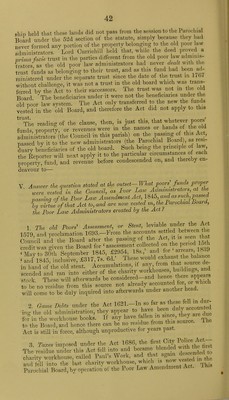
![shin held that these lauds did not pass from the session to the Parochial Board under the 52d section of the statute, simply because they had never formed any portion of the property belonging to the old poor law administrators. Lord CurriehiU held that, while the deed proved a prima facie trust in the parties different from the old poor law adminis- trators as the old poor law administrators had never dealt with the trust funds as belonging to their trust, and as this fund had been ad- ministered under the separate trust since the date of the trust in 17b7 without challenge, it was not a trust in the old board which was trans- ferred by the Act to their successors. The trust was not in the old Board The beneficiaries under it were not the beneficiaries under the old poor law system. The Act only transferred to the new the funds vested in the old Board, and therefore the Act did not apply to this tl'The reading of the clause, then, is just this, that whatever poors' funds property, or revenues were in the names or hands of the old BS7 the Council in this parish) on the passing of this Ac, passed by it to the new administrators (the Parochial Board), as resi- Ey beneficiaries of the old board. Such being the principle of aw the Reporter will next apply it to the particular circumstances of each property, fund, and revenue before condescended on, and thereby en- deavour to— V Answer the question stated at the outset-What poors] funds proper Were vested in the Council, as Poor Lau^Administrators, at the passing of the Poor Law Amendment Act, 1845 and as such passed In virtue of that Act to, and are now vested m the Parochial Boai d, the Poor Law Administrators created by the Act ? 1 The old Poors' Assessment, or Stent, leviable under the Act 1579, and proclamation 1693,-From the accounts settled between the Council and the Board after the passing of the Act, it i seen that credit was given the Board for < assessment collected on the period 15th ^May to 30th September 1845, £2954, 18s,' and for arrears, U89 ^andyi84t incksL, £317,7, 6d' These would^ausyl^nce in hand of the old stent. Accumulations if any from that scendedand ran into either of the chanty workhouses ^n^,and stock. These will afterwards be considered-and hen°e there^appeal* to be no residue from this source not already accounted fo\Zi will come to be duly inquired into afterwards under anothei head. 2. Game Debts under the Art 1621,-Inso ^^^^ ing the old administration, they appear to have been du 7 acc0Ullte^ for in the workhouse books. If any have fallen in s n£^aie™* to the Board, and hence there can be no residue from this source. Act is still in force, although unproductive for years past. 3. Taxes imposed under the Act 1686 the first The residue under this Act fell into and became blended vuth the first ^SSSS^M Paul's Work, a^V'rVCvS Sto and fell into the last charity workhouse, which is now vestea in Parochial Board, by operation of the Poor Law Amendment Act. 1 his](https://iiif.wellcomecollection.org/image/b21970610_0044.jp2/full/800%2C/0/default.jpg)


 No text description is available for this image
 No text description is available for this image
 No text description is available for this image