Licence: Public Domain Mark
Credit: Annual sanitary report of the Province of Assam. Source: Wellcome Collection.
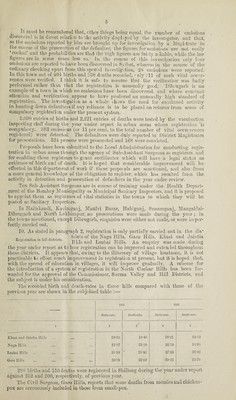
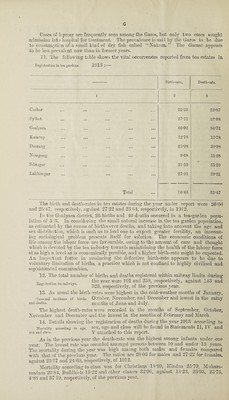
15/54 page 7
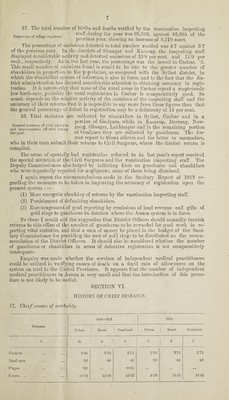
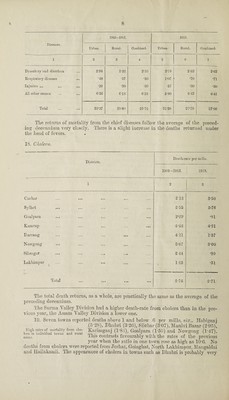
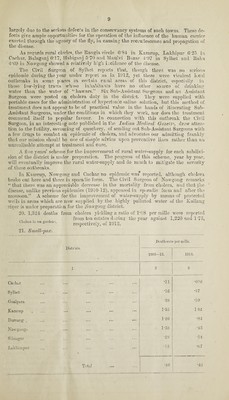
![lo. Tlie total number of births and deaths verified by the vaccination inspecting Inspection of village registers. staff during the year was 96,203, against 85,993 of the previous year, showing an increase of 9,210 cases. The percentage of omissions detected to total number verified was 47 against 37 of the previous year. In the districts of Sibsagar and Kamrup the inspecting staff displayed considerable activity and detected omissions of 15'8 per cent, and 11*9 per cent., respectively. As in the last year, the percentage was the lowest in Cachar, *5. This small number of omissions found is stated to be due to the greater number of chaukidars iu proportion to the population, as compared with the Sylhet district, in which the chaukidari system of collection is also in force, and to the fact that the dis¬ trict administration lias devoted considerable attention to obtaining accuracy in regis¬ tration. It is noteworthy that none of the rural areas in Cachar report a suspiciously low birth-rate, probably the rural registration in Cachar is comparatively good. So much depends on the relative activity of tlie members of the inspecting staff and the accuracy of their returns that it is impossible to say more from these figures than that the general percentage of defect in registration may be a deficiency of 15 per cent. 16. Vital statistics are collected by chaukidars in Sylhet, Cachar and in a portion of Goalpara, while in Kamrup, Darrang, Now- Sibsagar, Lakhimpur and in the remaining portion the year. or Goal para they are collected by gaonburas. The for¬ mer report to tliana officers and the latter to mauzadars, who in their turn submit their returns to Civil Surgeons, where the district return is compiled. The areas of specially had registration, referred to in last year’s report received the special attention of the Civil Surgeons and the vaccination inspecting staff. The Deputy Commissioners also helped by inflicting fines on gaonburas and chaukidars who were repeatedly reported for negligence, some of them being dismissed. I again repeat tlie recommendations made in the Sanitary Report of 1912 re¬ garding the measures to he taken in improving the accuracy of registration upon the present system : — (1) More energetic cheeking of returns by the vaccination inspecting staff. (2) Punishment of defaulting chaukidars. (3) Encouragement of good reporting by remissions of land revenue and gifts of gold rings to gaonburas in districts where the Assam system is in force. To these I would add the suggestion that District Officers should annually furnish returns to this office of the number of gaonburas to be rewarded for good work in re¬ porting vital statistics, and that a sum of money be placed in the budget of the Sani¬ tary Commissioner for providing the cost of gold rings to be distributed on the recom¬ mendation of the District Officers. It should also be considered whether the number of gaonburas or chaukidars iu areas of defective registration is not comparatively inadequate. Enquiry was made whether the services of independent medical practitioners could be utilized in verifying causes of death on a fixed rate of allowances on the system on trial in the United Provinces. It appears that the number of independent medical practitioners in Assam is very small and that the introduction of this proce¬ dure is not likely to be useful. SECTION VI. HISTORY OF CHIEF DISEASES. 17. Chief causes of mortality. Diseases. 1903—1912. 1913. Urban. Rural. Combined. • Urban. Rural. Combined. 1 2] 3 4 5 3 J 7 Cholera 246 274 2-74 1*16 2-74 271 Small-pox •93 •46 •46 •22 •46 •46 Plague ... •02 ... -0005 .... ... .*• • Fevers ... 10-03 1339 13-32 9-56 14 53 1443](https://iiif.wellcomecollection.org/image/b31495539_0015.jp2/full/800%2C/0/default.jpg)

 No text description is available for this image
 No text description is available for this image
 No text description is available for this image