Assessment criteria for determining environmental safety of plants with novel traits.
- Canada. Interdepartmental Executive Committee on Pest Management.
- Date:
- 1994
Licence: In copyright
Credit: Assessment criteria for determining environmental safety of plants with novel traits. Source: Wellcome Collection.
5/30
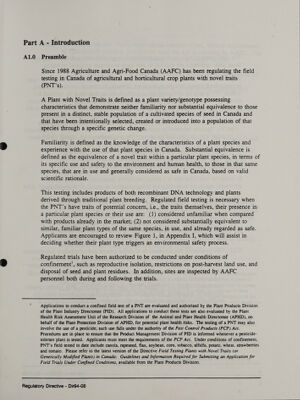
![Part A - Introduction A1.0 Preamble Since 1988 Agriculture and Agri-Food Canada (AAFC) has been regulating the field testing in Canada of agricultural and horticultural crop plants with novel traits (PNT’s). A Plant with Novel Traits is defined as a plant variety/genotype possessing characteristics that demonstrate neither familiarity nor substantial equivalence to those present in a distinct, stable population of a cultivated species of seed in Canada and that have been intentionally selected, created or introduced into a population of that species through a specific genetic change. Familiarity is defined as the knowledge of the characteristics of a plant species and experience with the use of that plant species in Canada. Substantial equivalence is defined as the equivalence of a novel trait within a particular plant species, in terms of its specific use and safety to the environment and human health, to those in that same species, that are in use and generally considered as safe in Canada, based on valid scientific rationale. This testing includes products of both recombinant DNA technology and plants derived through traditional plant breeding. Regulated field testing is necessary when the PNT’s have traits of potential concern, i.e., the traits themselves, their presence in a particular plant species or their use are: (1) considered unfamiliar when compared with products already in the market; (2) not considered substantially equivalent to similar, familiar plant types of the same species, in use, and already regarded as safe. deciding whether their plant type triggers an environmental safety process. Regulated trials have been authorized to be conducted under conditions of confinement’, such as reproductive isolation, restrictions on post-harvest land use, and disposal of seed and plant residues. In addition, sites are inspected by AAFC personnel both during and following the trials. : Applications to conduct a confined field test of a PNT are evaluated and authorized by the Plant Products Division of the Plant Industry Directorate (PID). All applications to conduct these tests are also evaluated by the Plant Health Risk Assessment Unit of the Research Division of the Animal and Plant Health Directorate (APHD), on behalf of the Plant Protection Division of APHD, for potentia] plant health risks. The testing of a PNT may also involve the use of a pesticide; such use falls under the authority of the Pest Control Products (PCP) Act. Procedures are in place to ensure that the Product Management Division of PID is informed whenever a pesticide- tolerant plant is tested. Applicants must meet the requirements of the PCP Act. Under conditions of confinement, PNT’s field tested to date include canola, rapeseed, flax, soybean, com, tobacco, alfalfa, potato, wheat, strawberries and tomato. Please refer to the latest version of the Directive Field Testing Plants with Novel Traits (or Genetically Modified Plants) in Canada: Guidelines and Information Required for Submitting an Application for Field Trials Under Confined Conditions, available from the Plant Products Division.](https://iiif.wellcomecollection.org/image/b32230242_0005.jp2/full/800%2C/0/default.jpg)