[Report 1938] / School Medical Officer of Health, Leeds City.
- Leeds City Council
- Date:
- 1938
Licence: Attribution 4.0 International (CC BY 4.0)
Credit: [Report 1938] / School Medical Officer of Health, Leeds City. Source: Wellcome Collection.
88/116 (page 86)
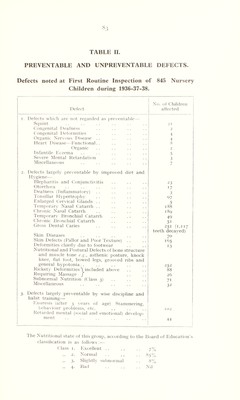
![I hat a certain reduction of defects occurs among the Nursery childien is shown by the following table, which contrasts the con¬ dition of 214 childien at the time of their hirst Routine Inspection with their condition after a year or more in the Nursery. TABLE IV. < ohimn i ( oluinn II Classification at I; irst Classification after One Inspection Year or more No. of No. of ('lass Children 0/ 0 Class ( hildren 0/ / O 1 II 35 1 7 J L r 20 I II 32 1 40 f 38 III (a) 19 14 111 (a) 22 \ 13 (b) '2 1 (b) 0 f IV (a) 37 ] IV (a) 4r, h (b) 09 (>6 (b) 54 > 49 Y 5 J V J J Certain points call for comment in Tables III and IV. 1. A discrepancy between Table III and Table IV, Column 1, in the percentages of children in the various categories is to be explained by the fact that Table IV refers to a group which is, to a certain extent, selected. That is to say, every effort is made to keep malnourished children, and those with chronic disorders in the Nursery Classes for 18 months or more, whereas it is un¬ fortunately necessanr sometimes to promote more sturdy children before they have completed a year’s attendance. 2. The serious amount of dental decay which occurs during the nursery years is indicated by a large increase in the numbers in Class II a year after admission. It is unfortunately the fact that the fate of these teeth was very largely determined during the pre-natal and early post-natal months, and the amount of dental hypoplasia noted among the entrants shows that the time for preventive measures lias already passed. There is, however, a good deal of evidence among ex-nursery children in the City to show that good feeding from the second to the fifth year has a favourable effect on the permanent dentition, even though it comes too late to save the deciduous teeth from decay. 3. The number of children who remain in Class IV after twelve months or more points to the chronicity of the conditions included under this heading. A really substantial reduction of these defects occurs only in those children who have had two years or more in the nurseries. Where the Nursery Class accommodation in an](https://iiif.wellcomecollection.org/image/b29723188_0088.jp2/full/800%2C/0/default.jpg)