[Report 1949] / Medical Officer of Health, Somerset County Council.
- Somerset Council
- Date:
- 1949
Licence: Attribution 4.0 International (CC BY 4.0)
Credit: [Report 1949] / Medical Officer of Health, Somerset County Council. Source: Wellcome Collection.
71/104 (page 69)
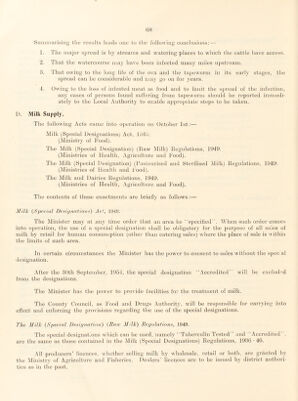
![()<) Dealers' licences are for a period of one year from the 1st January. Licences to use the designation “Tuhei'culin Tested” are to be for a periofl of five years providing the herd from which the milk is produced is ‘‘Attested ’. W here tlie milk is from a lierd not ‘‘Attested”, ai)plications made for ‘‘Tuberculin Tested’ licences are limited to three years providing such application is made before tlie 1st October, 11151. Thev are not renewable thereafter. No “Tuberculin Tested” licences will be granted after October 1st, 1954, unless the herd is “Attested”. No consideration will be given to applications for “Accredited” licences after bOth Septenir ber, 1952, and all existing licences will expire after 30th September, 1954. Tilt Milk {Special JJesii/iKifiiin) (Pasfeiiri.sed and Sterilised Milk) Beijulaiionx, 1949. Food and Drugs Authorities, in Somerset the County Council, are now responsible for licensing pasteurising and sterilising plants in place of District Authorities. Dealers’ licences (where milk is not pasteurised or steiilised on the premises) are issued by District Councils as hitherto; they also grant supplementary licences to dealers who wish to sell milk in the area but whose premises are outside the district of the local authority. The licences for both pasteurising and sterilising plants are for one year, from the 1st January. Dealers’ licences are issued for the same period. The authorised designations are “Pasteurised” Tested” milk only is processed the additional wording and “Sterilised”. Wliere “Tuberculin “Tuberculin Tested milk” is permitted. ]\lilk may be pasteurised in two ways: {a} by the holder method which means that the milk must be held between the temperature limits of 145° F. to 15(1°, [b) by the H.T.S.T. (high tem¬ perature short time) method when the milk must be held at not less than lbl° F. for at least hfteen seconds. With regard to the time-temperature combination, the only change from the old Pegula- tioiis is that in the H.T.S.T. method the temperature has been reduced from 102° F. to 101° F. In a note with the liegulations indicating their general purport, from a future date to be appointed by the IMinister of Food, a How diversion device must be fitted to pasteurising plant in which the milk is heated to a temperature higher than 150° F. and bottles or other containers must be securely fastened with an ovei'lapping caj). From 1st October, 1950, jiasteurised milk iiiay only be sold in bottles or other containers which must be tilled on the premises of a person holding a licence under these regulations. From 1st October, 1954, the bottles or other containers must be filled at the pasteurising premises. Sterilised milk is milk which has been filtered, homogenised and heated to and maintained at a temperature of not loss than 212° F. for such period as to ensure that it will comply with the piesci'ibed turbidity test. Sterilised is a new designation. The Milk and Dairies litijidatinns, 1949. 'I’liese Pegulations re-enact, with amendmeiits, the Milk and D.-iiiles llegidatioiis, I92b to 1943.](https://iiif.wellcomecollection.org/image/b30111912_0071.jp2/full/800%2C/0/default.jpg)