An introduction to physiology / by Augustus D. Waller.
- Augustus Desiré Waller
- Date:
- 1893
Licence: Public Domain Mark
Credit: An introduction to physiology / by Augustus D. Waller. Source: Wellcome Collection.
607/674 page 585
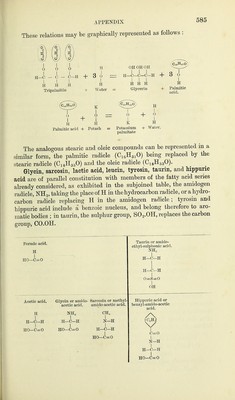
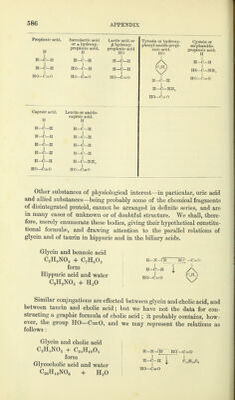
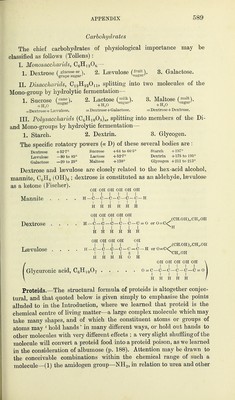
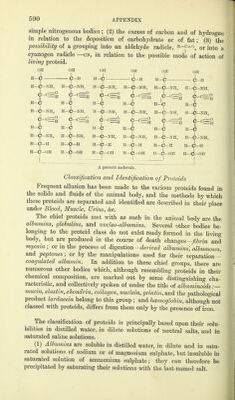
![These relations may be graphically represented as follows 1 i] i) \kSJ \ 1 0 1 0 1 : 0 H OH OH OH 1 H—0 — 1 0 — Lu + H—C—0—C—H + Tripalmitin 1 H -1- i Water = Grlyceriu + H Palmitic acid + K H Potassium + Water, palmitate The analogous stearic and oleic compounds can be represented in a similar form, the palmitic radicle (CigHgiO) being replaced by the stearic radicle (CigHasO) and the oleic radicle (CigHgaO). Glycin, sarcosin, lactic acid, leucin, tyrosin, taurin, and hippunc acid are of parallel constitution with members of the fatty acid series already considered, as exhibited in the subjoined table, the amidogen radicle, NH2, taking the place of H in the hydrocarbon radicle, or a hydro- carbon radicle replacing H in the amidogen radicle ; tyrosin and hippuric acid include a benzoic nucleus, and belong therefore to aro- matic bodies ; in taurin, the sulphur group, SO2.OH, replaces the carbon group, CO.OH. Formic acid. H HO—0 = 0 Acetic acid. H I H—O-H I HO—0 = 0 Glycin or amido- Sarcosin or methyl- acetic acid. amido-acetic acid. NH^ OH3 H—C—H HO—C=0 H—0—H HO—C=0 Taurin or amido- ethyl-siUplionic acid. NH. 1 ' H—0—H H—C-H o=s=o o'h Hippuric acid or benzyl-amido-acetic acid. /\ (CsHJ 0=0 I N—H I H—C—H I](https://iiif.wellcomecollection.org/image/b20412514_0607.jp2/full/800%2C/0/default.jpg)
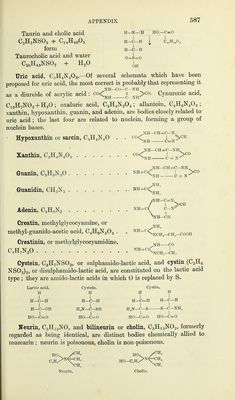
 No text description is available for this image
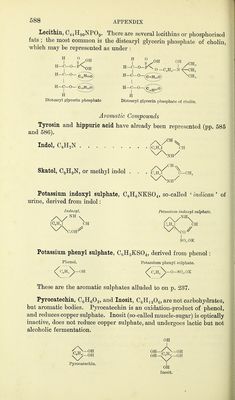
 No text description is available for this image
 No text description is available for this image