On corpulence in relation to disease : with some remarks on diet / by William Harvey.
- Date:
- 1872
Licence: Public Domain Mark
Credit: On corpulence in relation to disease : with some remarks on diet / by William Harvey. Source: Wellcome Collection.
Provider: This material has been provided by the Royal College of Physicians of Edinburgh. The original may be consulted at the Royal College of Physicians of Edinburgh.
156/185 page 140
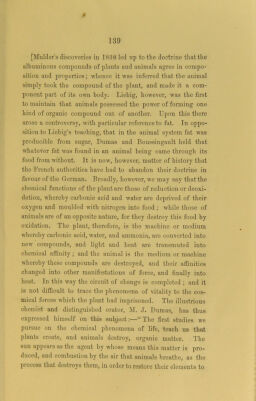
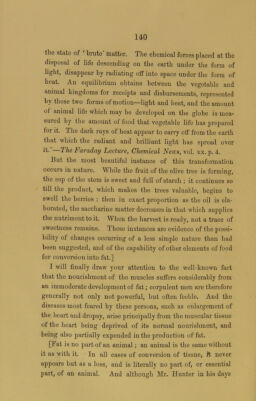
![the state of * brute’ matter. The chemical forces placed at the disposal of life descending on the earth under the form of light, disappear by radiating ojBF into space under the form of heat. An equilibrium obtains between the vegetable and animal kingdoms for receipts and disbursements, represented by these two forms of motion—light and heat, and the amount of animal life which may be developed on the globe is mea- sured by the amount of food that vegetable life has prepared for it. The dark rays of heat appear to carry oflp from the earth that which the radiant and brilliant light has spread over The Faraday Lecture, Chemical News, vol. xx. p. 4. But the most beautiful instance of this transformation occurs in nature. While the fruit of the olive tree is forming, the sap of the stem is sweet and full of starch ; it continues so till the product, which makes the trees valuable, begins to swell the berries : then in exact proportion as the oil is ela- borated, the saccharine matter decreases in that which supplies the nutriment to it. When the harvest is ready, not a trace of sweetness remains. These instances are evidence of the possi- bility of changes occurring of a less simple nature than had been suggested, and of the capability of other elements of food for conversion into fat.] I will finally draw your attention to the well-known fact that the nourishment of the muscles suffers considerably from an immoderate development of fat; corpulent men are therefore generally not only not powerful, but often feeble. And the diseases most feared by these persons, such as enlargement of the heart and dropsy, arise principally from the muscular tissue of the heart being deprived of its normal nourishment, and being also partially expended in the production of fat. [Fat is no part of an animal; an animal is the same without it as with it. In all cases of conversion of tissue, ft never appears but as a loss, and is literally no part of, or essential part, of an animal. And although Mr. Hunter in his days](https://iiif.wellcomecollection.org/image/b21950520_0156.jp2/full/800%2C/0/default.jpg)