Report of the War Office Committee of Enquiry into "Shell-shock."
- Great Britain. War Office. Committee of Enquiry into "Shell-shock"
- Date:
- 1922
Licence: Public Domain Mark
Credit: Report of the War Office Committee of Enquiry into "Shell-shock.". Source: Wellcome Collection.
202/226 page 196
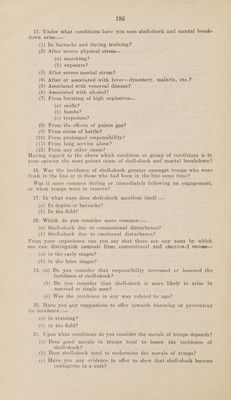
![15. Under what conditions have you seen shell-shock and mental break- down arise :— (1) In barracks and during training? (2) After severe physical stress— (a) marching? (6) exposure? (5) After severe mental stress? (4) After or associated with fever—dysentery, malaria, etc.? (5) Associated with venereal disease? (6) Associated with alcohol? (7) From bursting of high explosives— (a) shells? (b) bombs? (c) torpedoes P (8) From the effects of poison gas? (9) From stress of battle? (10) From prolonged responsibility ? (11) From long service alone? (12) From any other cause? Having regard to the above which condition or group of conditions is in your opinion the most potent cause of shell-shock and mental breakdown ? 16. Was the incidence of shell-shock greater amongst troops who were fresh in the line or in those who had been in the line some time? Was it more common during or immediately following an engagement, or when troops were in reserve? 17. In what ways does shell-shock manifest itself :— (a) In depots or barracks? (b) In the field? 18. Which do you consider more common :— (a) Shell-shock due to commotional disturbance? (b) Shell-shock due to emotional disturbance? From your experience can you say that there are any tests by which one can distinguish neurosis from commotional and emotions] causes— (a) in the early stages? (b) in the later stages? 19. (a) Do you consider that responsibility increased or lessened the incidence of shell-shock ? (6) Do you consider that shell-shock is more likely to arise in married or single men? (c) Was the incidence in any way related to age? 20. Have you any suggestions to offer towards lessening or preventing its incidence : — (a) in training? (b) in the field P 21. Upon what conditions do you consider the morale of troops depends ? (a) Does good morale in troops tend to lessen the incidence of shell-shock ? (b) Does shell-shock tend to undermine the Shela of troops? (c) Have you any evidence to offer to show that shell-shock became contagious in a unit?](https://iiif.wellcomecollection.org/image/b3217777x_0202.jp2/full/800%2C/0/default.jpg)