[Report 1959] / Medical Officer of Health, Maidstone U.D.C. / Borough.
- Maidstone (England). Urban District Council.
- Date:
- 1959
Licence: Attribution 4.0 International (CC BY 4.0)
Credit: [Report 1959] / Medical Officer of Health, Maidstone U.D.C. / Borough. Source: Wellcome Collection.
14/60 page 11
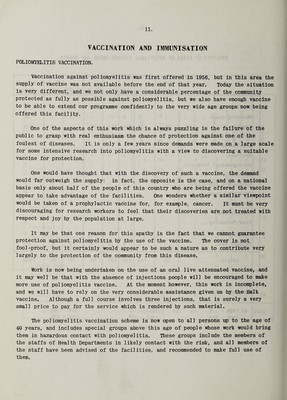
![VACCINATION AND IMMUNISATION POLIOMYELITIS VACCINATION. Vaccination against poliomyelitis was first offered in 1956, but in this area the supply of vaccine was not available before the end of that year. Today the situation is very different, and we not only have a considerable percentage of the community protected as fully as possible against poliomyelitis, but we also have enough vaccine to be able to extend our programme confidently to the very wide age groups now being offered this facilitye One of the aspects of this work which is always puzzling is the failure of the public to grasp with real enthusiasm the chance of protection against one of the foulest of diseases. It is only a few years since demands were made on a large scale for some intensive research into poliomyelitis with a view to discovering a suitable vaccine for protection. One would have thought that with the discovery of such a vaccine, the demand would far outweigh the supply: in fact, the opposite is the case, and on a national basis only about half of the people of this country who are being offered the vaccine appear to take advantage of the facilities. One wonders whether a similar viewpoint would be taken of a prophylactic vaccine for, for example, cancer. It must be very discouraging for research workers to feel that their discoveries are not treated with respect and joy by the population at large. It may be that one reason for this apathy is the fact that we cannot guarantee protection against poliomyelitis by the use of the vaccine. The cover is not fool-proof, but it certainly would appear to be such a nature as to contribute very largely to the protection of the community from this disease. Work is now being undertaken on the use of an oral live attenuated vaccine, and it may well be that with the absence of injections people will be encouraged to make more use of poliomyelitis vaccine. At the moment however, this work is incomplete, and we will have to rely on the very considerable assistance given us by the Salk vaccine. Although a full course involves three injections, that is surely a very small price to pay for the service which is rendered by such materia]. The poliomyelitis vaccination scheme is now open to al1 persons up to the age of 40 years, and includes special groups above this age of people whose work would bring them in hazardous contact with poliomyelitis. These groups include the members of the staffs of Health Departments in likely contact with the risk, and all members of the staff have been advised of the facilities, and recommended to make full use of them.](https://iiif.wellcomecollection.org/image/b29780883_0014.jp2/full/800%2C/0/default.jpg)