The menace of colour : a study of the difficulties due to the association of white & coloured races, with an account of measures proposed for their solution, & special reference to white colonization in the tropics / J. W. Gregory.
- John Walter Gregory
- Date:
- 1925
Licence: In copyright
Credit: The menace of colour : a study of the difficulties due to the association of white & coloured races, with an account of measures proposed for their solution, & special reference to white colonization in the tropics / J. W. Gregory. Source: Wellcome Collection.
60/272 page 60
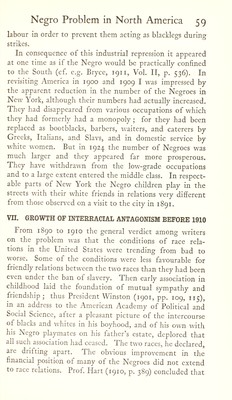
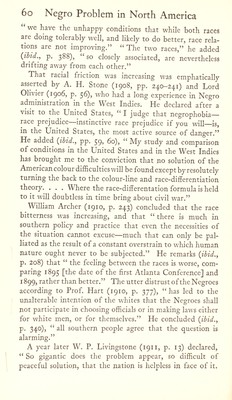
![“ we ^ave the unhappy conditions that while both races are doing tolerably well, and likely to do better, race rela¬ tions are not improving.” “The two races,” he added {ibid., p. 388), “ so closely associated, are nevertheless drifting away from each other.” That racial friction was increasing was emphatically asserted by A. H. Stone (1908, pp. 240-241) and Lord Olivier (1906, p. 56), who had a long experience in Negro administration in the West Indies. He declared after a visit to the United States, “ I judge that negrophobia— race prejudice—instinctive race prejudice if you will—is, in the United States, the most active source of danger.” He added {ibid., pp. 59, 60), “ My study and comparison of conditions in the United States and in the West Indies has brought me to the conviction that no solution of the American colour difficulties will be found except by resolutely turning the back to the colour-line and race-differentiation theory. . . . Where the race-differentation formula is held to it will doubtless in time bring about civil war.” William Archer (1910, p. 243) concluded that the race bitterness was increasing, and that “ there is much in southern policy and practice that even the necessities of the situation cannot excuse—much that can only be pal¬ liated as the result of a constant overstrain to which human nature ought never to be subjected.” He remarks {ibid., p. 208) that “ the feeling between the races is worse, com¬ paring 1895 [the date of the first Atlanta Conference] and 1899, rather than better.” The utter distrust of the Negroes according to Prof. Hart (1910, p. 377), “has led to the unalterable intention of the whites that the Negroes shall not participate in choosing officials or in making laws either for white men, or for themselves.” He concluded {ibid., p. 340), “ all southern people agree that the question is alarming.” A year later W. P. Livingstone (1911, p. 13) declared, “ So gigantic does the problem appear, so difficult of peaceful solution, that the nation is helpless in face of it.](https://iiif.wellcomecollection.org/image/b29815095_0060.jp2/full/800%2C/0/default.jpg)