The life of Thomas Linacre : Doctor of Medicine, physician to King Henry VIII; the tutor and friend of Sir Thomas More, and the founder of the college of physicians in London : with memoirs of his contemporaries, and of the rise and progress of learning, more particularly of the schools from the ninth to the sixteenth century inclusive / by John Noble Johnson ; edited by Robert Graves.
- Johnson, John Noble, 1787-1823.
- Date:
- 1835
Licence: Public Domain Mark
Credit: The life of Thomas Linacre : Doctor of Medicine, physician to King Henry VIII; the tutor and friend of Sir Thomas More, and the founder of the college of physicians in London : with memoirs of his contemporaries, and of the rise and progress of learning, more particularly of the schools from the ninth to the sixteenth century inclusive / by John Noble Johnson ; edited by Robert Graves. Source: Wellcome Collection.
Provider: This material has been provided by The University of Glasgow Library. The original may be consulted at The University of Glasgow Library.
337/392 page 315
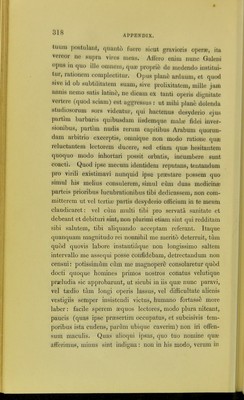
![fiducia est: quae si me non frustrabitiir, et litterarium hoc munusculiim laeta fronte accipies: non mihi modo majora quae premo edendi animum addideris, sed etiam alios ex tuis ad multa quee te et saeculura fortasse tuum illustrent, scribenda excitabis. Diu vivas precor Regum splendor, et sEeculi tui decus. Londini xvi. Calen. Quintiles. Anno salutis Christianas M.D.xvij. IV. {Page 213.) [Prefixed in MS. to tlie presentation copy on vellum of the translation pf Galen De Sanitate tuendil, in the British Museum. Printed at Paris by Rubeus in 1517.] Reverendissimo in Christo Patri et Domino, Domino Thomae, divina providentia Tituli Sanctee Cecilise Pres- bytero Cardinali, Archiepiscopo Eboracensi, Apostolicss sedis Legato, Angliae Primati et Cancellario: Thomas Linacrus Medicus debitam observantiam. Quas proxime lucubrationes meas Clarissimo Regi nostro dedicavi, earum, Reverendissime Pater, exemplum nunc ad te mitto. Quo tuae quoque sanitati pro virili, secundum illius, consulam. Id quod optimo jure me facere existimo, c^m tu ejus tranquillati, serenatatique ita consulis ne (quod indignissimum alioqui sit,) curas ullae sanitatem ejus possint convellere. Utinamque ipse per immensas occupationes tuas lucubrationes has posses perlegere. Invenies (nisi me nimium amor operis fallit) quod nonnihil ex stomacho tuo evocet. Qui pro singulari eruditione tua, non protinus quidlibet, sed tantum quod solida ratio munivit, admittis. Hic autem nihil est gratis (ut aiunt) dictum. Sed omnia, partim certa methodo inventa, partim firmissimis rationibus](https://iiif.wellcomecollection.org/image/b21471496_0339.jp2/full/800%2C/0/default.jpg)