The banana : its cultivation, distribution and commercial uses / by William Fawcett, with an introduction by Sir Daniel Morris. Pub. under the auspices of the West India committee.
- William Fawcett
- Date:
- 1913
Licence: In copyright
Credit: The banana : its cultivation, distribution and commercial uses / by William Fawcett, with an introduction by Sir Daniel Morris. Pub. under the auspices of the West India committee. Source: Wellcome Collection.
87/332 page 61
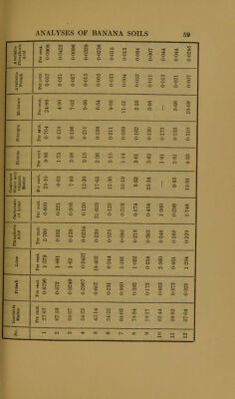
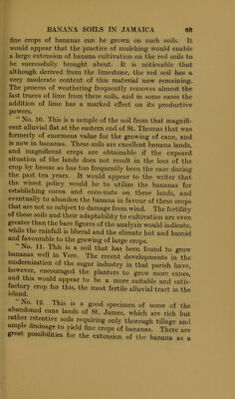
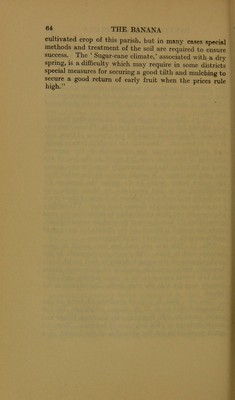
![inadequate conditions of drainage or of tillage may in the near future yield success to planters with more enterprise and knowledge than their predecessors who have tried and failed. “ For present purposes, a few soils typical of different classes and types of land on which bananas are grown with success have been selected and their composition and analysis set forth [on pp. 58 and 59]. Observations “ No. 1 represents a very rieh deposit overlying the limestone on an estate in Portland where magnificent bananas were grown year after year. This might be taken as an ideal banana soil—^rich in humus and available plant food and of a rather retentive but not impervious consistency. “ No. 2 is an average alluvial soil in Portland that has been long under cultivation and is on the limit of pro- ductivity as first-class banana land. This is a light soil from which the humus is rapidly abstracted under cultiva- tion with a high rainfall. The present standard of humus is low and the nitrogen also below par. Chemical fertilizers when tried on this soil were inoperative. The provision of vegetable matter to restore the humus is clearly the problem to be faced in this case. “ No. 3 is a representative of a non-calcareous alluvial soil in St. Mary where excellent bananas are and have been grown for many years by good tillage and green dressings. No. 4 is a type of the heavy banana soils of this parish. Forking and deep drainage have worked wonders on this material. No. 5 is a representative of the alluvial deposits rich in calcareous matter that are largely found in St. Mary. This soil failed to respond to the most generous applications of chemical manures, but at once yielded a full grade of fruit when subjected to thorough implemental tillage and top dressings of cowpeas.](https://iiif.wellcomecollection.org/image/b28089807_0087.jp2/full/800%2C/0/default.jpg)