Licence: Public Domain Mark
Credit: The spectroscope and its applications / by J. Norman Lockyer. Source: Wellcome Collection.
Provider: This material has been provided by the Royal College of Physicians of Edinburgh. The original may be consulted at the Royal College of Physicians of Edinburgh.
131/146 page 113
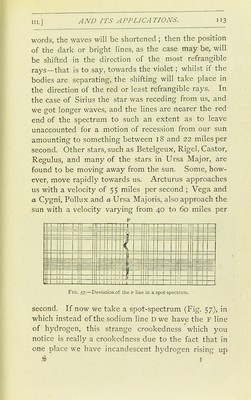
![111.] words, the waves will be shortened ; then the position of the dark or bright lines, as the case may be, will be shifted in the direction of the most refrangible rays—that is to say, towards the violet; whilst if the bodies are separating, the shifting will take place in the direction of the red or least refrangible rays. In the case of Sirius the star was receding from us, and we got longer waves, and the lines are nearer the red end of the spectrum to such an extent as to leave unaccounted for a motion of recession from our sun amounting to something between 18 and 22 miles per second. Other stars, such as Betelgeux, Rigel, Castor, Regulus, and many of the stars in Ursa Major, are found to be moving away from the sun. Some, how- ever, move rapidly towards us. Arcturus approaches us with a velocity of 55 miles per second ; Vega and a Cygni, Pollux and a Ursa Majoris, also approach the sun with a velocity varying from 40 to 60 miles per p H 1 1 11 1 1 ft 1 1 1 1 1 11 1 1 1 1 V 1 1 1 Fig. 57.—Deviation of the F line in a spot-spectrum. second. If now we take a spot-spectrum (Fig. 57), in which instead of the sodium line Dwe have the F line of hydrogen, this strange crookedness which you notice is really a crookedness due to the fact that in one place we have incandescent hydrogen rising up % ^ I](https://iiif.wellcomecollection.org/image/b21976752_0133.jp2/full/800%2C/0/default.jpg)