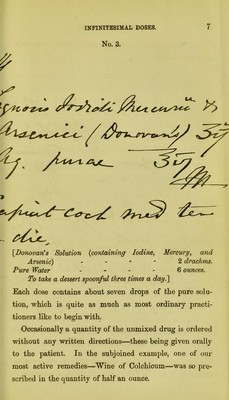
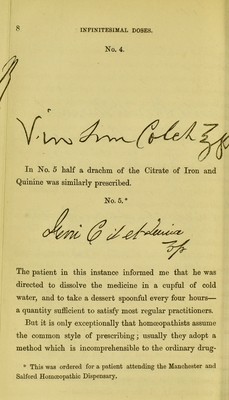
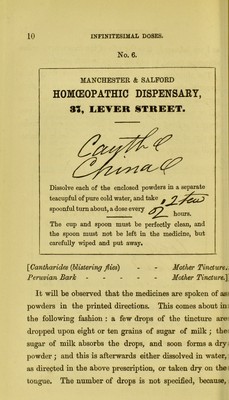
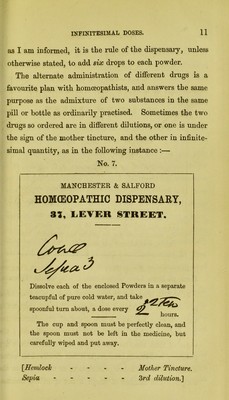
Homoeopathy, as practised in Manchester : contrasted with its alleged principles / by William Roberts.
- Roberts, Sir William, 1830-1899.
- Date:
- 1862
Licence: Public Domain Mark
Credit: Homoeopathy, as practised in Manchester : contrasted with its alleged principles / by William Roberts. Source: Wellcome Collection.
Provider: This material has been provided by The Royal College of Surgeons of England. The original may be consulted at The Royal College of Surgeons of England.
24/96 (page 12)
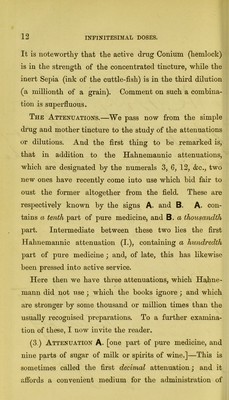
![It is noteworthy that the active drug Conium (hemlock) is in the strength of the concentrated tincture, while the inert Sepia (ink of the cuttle-fish) is in the third dilution (a millionth of a grain). Comment on such a combina- tion is superfluous. The Attenuations.—We pass now from the simple drug and mother tincture to the study of the attenuations or dilutions. And the first thing to be remarked is, that in addition to the Hahnemaunic attenuations, which are designated by the numerals 3, 6, 12, &c., two new ones have recently come into use which bid fair to oust the former altogether from the field. These are respectively known by the signs A. and B. A. con- tains a tenth part of pure medicine, and B. a thousandth part. Intermediate between these two lies the first Hahnemaunic attenuation (I.), containing a hundredth part of pure medicine ; and, of late, this has likewise been pressed into active service. Here then we have three attenuations, which Hahne- mann did not use ; which the books ignore ; and which are stronger by some thousand or million times than the usually recognised preparations. To a further examina- tion of these, I now invite the reader. (3.) Attenuation A. [one part of pure medicine, and nine parts of sugar of milk or spirits of wine.]—This is sometimes called the first decimal attenuation; and it affords a convenient medium for the administration of](https://iiif.wellcomecollection.org/image/b22319323_0026.jp2/full/800%2C/0/default.jpg)