An introductory Hebrew grammar with progressive exercises in reading and writing / by A.B. Davidson.
- Andrew B. Davidson
- Date:
- 1909
Licence: In copyright
Credit: An introductory Hebrew grammar with progressive exercises in reading and writing / by A.B. Davidson. Source: Wellcome Collection.
34/232 (page 22)
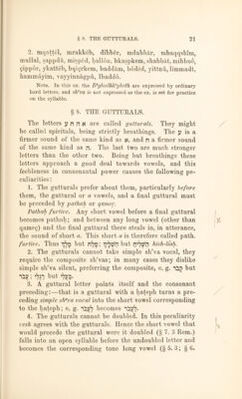
![Table h c); e. g. niin hak-kehhedh but ha-ehhedh, but tej? but Bern, a. On 1. Tlie sharp vowels i, u, falling before gutturals not final, are generally depressed to e, o, as nearer the a sound (§ 6. 3 Table d). The depression happens less regularly when the vowels follow the gutt.; e. g. ^^n;. for for The letter ^ (being a quiescent also, see §9.1 Bern, a) is excepted from this rule. The letter often agrees with in desiring pafhah before it when final, but it is not subject to the rule of path, furtive. The sign of path, furtive is written under the final gutt., hut the sound is heard before it, as ruah, spirit. Path, furtive is not counted as a vowel, and, of course, disappears when the gutt. ceases to be final; e. g. has only two vowels, i and 1] its fern, is So my spirit. Bern. h. On 2. By far the most common hateph is —. Initial 8 is fond of -::7- immediately before the tone, but at a distance from the tone it reverts to —, as but The hateph that takes the place of silent slfva always corres- ponds to the preceding short vowel, as (for The second half of the rule applies chiefly to syllables not in the tone, and the process is facilitated by the law stated in Bern, a whereby the gutt. depresses ^ to e o, e. g. = =® This softer enunciation shews itself chiefly with the weak gutturals the harder H H often retain the simple sh®va silent. Bern. c. On 3. This rule and the second half of rule 2 really go together and might be compressed into one in the words of the old grammars: “littera gutturalis punctat se et prsecedentem” et vice versa. The words vice versa form the second half of rule 2. Buie 3 applies greatly to prefixes, e. g. to a lion. Bern. d. On 4. As the cause that produces the tone-long in this case is permanent, the vowel is unchangeable. Before the stronger gutt. H H, the short vowel is very often retained, and sometimes even before the weaker ^ To prevent the special emphasis of the short vowel in this case](https://iiif.wellcomecollection.org/image/b29006752_0034.jp2/full/800%2C/0/default.jpg)