An introductory Hebrew grammar with progressive exercises in reading and writing / by A.B. Davidson.
- Andrew B. Davidson
- Date:
- 1909
Licence: In copyright
Credit: An introductory Hebrew grammar with progressive exercises in reading and writing / by A.B. Davidson. Source: Wellcome Collection.
43/232 (page 31)
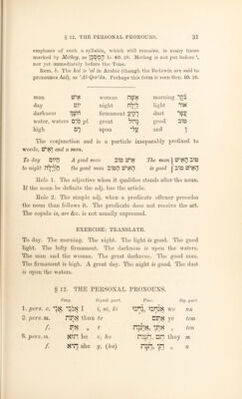
![emphasis of such a syllable, which still remains, is many times marked by Metheg, as ]3Dttn Is. 40. 20. Metheg is not put before ^ nor yet immediately before the Tone. Rem. 1). The hal is ^al in Arabic (though the Bedawin are said to pronounce hal), as ’Al-Qor'd7i. Perhaps this form is seen Gen. 10. 26. man woman T • day nv night XI- darkness firmament water, waters D'lfe ph great bm X high T upon b)l morning light niN dust IDj; good UlltO and ) t The conjunction and is a particle inseparably prefixed to words, and a man. To day Dlhl A good man HtD The man | lltO to night the good man nitSH is good | nitO Rule 1. The adjective when it qualifies stands after the noun. If the noun he definite the adj. has the article. Rule 2. The simple adj. when a predicate oftener precedes the noun than follows it. The predicate does not receive the art. The copula is, are &c. is not usually expressed. EXERCISE: TRANSLATE. To day. The morning. The night. The light is good. The good light. The lofty firmament. The darkness is upon the waters. The man and the woman. The great darkness. The good man. The firmament is high. A great day. The night is good. The dust is upon the waters. §12. THE PERSONAL PRONOUNS. Sing. Signif. part. Plur. Sig part. l.pers. c. I i, ni, ki ^:n3, we nu 2. pe7's. m. thou ta DriN ye iem f- pN „ t nrnx, -jns „ ten ^.pers.m. lie V, hn Dn X ' •• they m f. X'H she y, {ha) Mih, in T ' 1 •• n n](https://iiif.wellcomecollection.org/image/b29006752_0043.jp2/full/800%2C/0/default.jpg)