A practical treatise on the management and diseases of children / by Richard T. Evanson and Henry Maunsell.
- Evanson, Richard Tonson, 1800-1871.
- Date:
- 1843
Licence: Public Domain Mark
Credit: A practical treatise on the management and diseases of children / by Richard T. Evanson and Henry Maunsell. Source: Wellcome Collection.
Provider: This material has been provided by the National Library of Medicine (U.S.), through the Medical Heritage Library. The original may be consulted at the National Library of Medicine (U.S.)
40/412
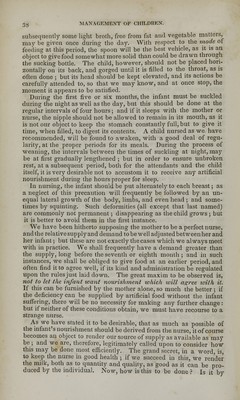
![eight or ten hours, or even earUer, as is often the case, we think the infant should then be appUed to the breast; and that it is highly- desirable to avoid giving, in the interim, any other food whatsoever. Should the secretion of milk not be perfectly established for two or three days, as sometimes happens, the child will be cross and evince signs of hunger, and we shall then generally find it necessary to give a small quantity of thin gruel, mixed with a little milk. Even in these cases, Professor Jorg recommends, that nothing should be given but a few teaspoonfuls of lukewarm water; and we happen to know that such is his practice, without any bad results, in the Lying-in Hospital of Leipzig. Notwithstanding this, however, should it not be practicable to have the child suckled within ten or twelve hours after birth, we think it advisable to give, every five or six hours, a few teaspoonfuls of such food as has been mentioned above, but to desist immediately upon a nurse being procured, or the mother becoming herself capable of supplying sufficient nourishment. Having premised thus much respecting the attentions required by the infant immediately upon its entrance into the world, we shall now proceed to consider its further management with regard to food, cleanliness, clothing, sleep, exercise, medicine, and the action upoa it of physical agents, as light, air, and heat. III. FOOD IN THE FIRST PERIOD. It is unnecessary to go at any length into the question of the pro* priety of mothers nursing their own children; the weight of the moral and physical considerations which leave no choice as to the propriety of obeying the dictates of nature, being now universally acknowledged. Women are not, at least at the present time, and in these countries, the unnatural deserters of their offspring that sys- tematic writers would lead us to suppose ; and, we think, most experienced physicians will join us in declaring, that our duty less frequently is, to urge maternal nursing, than to explain, and even enforce, in individual instances, the exceptional causes whereby nature herself sometimes renders it impossible or inexpedient to com- ply with her general law. We are, in fact, oftener obliged to save an infant from destruction, and a delicate mother from injury, by forbidding ineffectual attempts at nursing, on the part of the latter, than we are called upon to remind a robust and healthy parent of the urgency of the natural claims upon her. We shall therefore assume, as a general rule, that all mothers should nurse their own children; and merely indicate those cases in which it becomes necessary to substitute another mode of rearing the child. Women who labour under any mortal or weakening disease,— as phthisis, hemorrhages, epilepsy, &c., —are obviously disqualified for the office of nurse; some, who are in other respects healthy, ha.ve breasts incapable of secreting a sufficient supply of milk, and this may be temporarily the case with one child (especially the first), while upon other occasions the same individuals make excellent nurses. ]n other instances the breast may perform its functions](https://iiif.wellcomecollection.org/image/b21118346_0040.jp2/full/800%2C/0/default.jpg)