A practical treatise on the management and diseases of children / by Richard T. Evanson and Henry Maunsell.
- Evanson, Richard Tonson, 1800-1871.
- Date:
- 1843
Licence: Public Domain Mark
Credit: A practical treatise on the management and diseases of children / by Richard T. Evanson and Henry Maunsell. Source: Wellcome Collection.
Provider: This material has been provided by the National Library of Medicine (U.S.), through the Medical Heritage Library. The original may be consulted at the National Library of Medicine (U.S.)
69/412
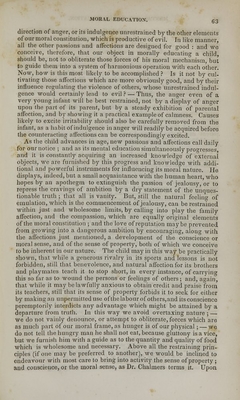
![To work out in practice the principles we have attempted to lay down, we are well aware, would require qualifications on the part of the parent or teacher, of no ordinary kind; and will, nodoubt, in too many cases be impossible of accomplishment: but the nearer we can approach to them, the more likely are we to produce the mens sana, which we feel confident is fully as certain of producing, as of inhabit- ing, the corpus sa?ium. Our limits forbid us to enter at greater length into this most inter- esting subject; but one word we must add, to prevent misconception. We have not yet spoken of religious instruction as a part of moral education, because we have been considering the management of the moral faculties as they exist in the natural man : we are deeply con- vinced, however, of its necessity and importance ; and we are firmly of opinion, that in no way can we promote the interests of an indi- vidual, both as regards himself and his relations with society, so effec- tually, as by encouraging in him early habits of religious observ- ances ; in no way can we so surely call forth and strengthen his best affections, as by early setting before his view the living truths of revelation. As general conclusions from the views we have put forward, we \yould say, that during childhood (/. e., until the eighth year) educa- tion should have for its main object the cultivation of the moral qualities ; and that, during the greater portion of the same period, the intellect will be pretty fully occupied in obtaining such most necessary information, as can be acquired by the use of the senses without much ybrw^a/assistance, and therefore that schooling, pro- perly so called, should not be commenced, at the very earliest, before the termination of the sixth year. Until then, the confinement of a school is injurious to the bodily health, and not required for the men- tal improvement of the child. In coming to these conclusions, we may appear to undervalue those useful inventions of late years,— infant schools. We conceive, however, that they are designed for a specific purpose, which, when well regulated, they effect usefully — viz., to take charge of the children of the poor in large cities, when their parents are engaged in daily labour, and unable to attend to their wants. In this view, the value of these institutions is inestima- ble ; but still they are but the substitution of a lesser for a greater evil: all the ties of social affection, of well-regulated obedience, and of mutual co-operation, which constitute the bonds of society, are learned by the infant in the domestic circle, andean be learned nowhere else. If we can leave it, therefore, in the care of an intelligent mother, and in the society of its brothers and sisters, we should not send it to an infant school, where it is governed by, and associated with, stran- gers, with none of whom it is likely to have natural sympathies. What the child may be expected to gain specifically in these schools, ginning to prevail; and especially that they have been adopted by the Select Com- mittee of the House of Commons in their late report on Education in Ireland. In this masterly document, v^hich we understand to be the work of Mr. Wyse, music is included among the subjects of instruction in the proposed elementary schools. [Note to 3d Edition.] 6*](https://iiif.wellcomecollection.org/image/b21118346_0069.jp2/full/800%2C/0/default.jpg)