A practical treatise on the management and diseases of children / by Richard T. Evanson and Henry Maunsell.
- Evanson, Richard Tonson, 1800-1871.
- Date:
- 1843
Licence: Public Domain Mark
Credit: A practical treatise on the management and diseases of children / by Richard T. Evanson and Henry Maunsell. Source: Wellcome Collection.
Provider: This material has been provided by the National Library of Medicine (U.S.), through the Medical Heritage Library. The original may be consulted at the National Library of Medicine (U.S.)
70/412
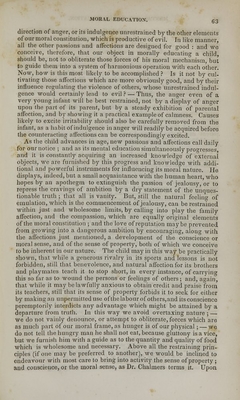
![beyond mere protection, can only be regularity of habits, which cer- tainly is of great importance, but not so great as to countervail the advantages of a well-regulated domestic circle. For the reasons we have advanced, we conceive that infant schools, though most service- able in large cities for the poor, are totally unfitted for the children of more opulent parents. With the latter, the system might be cha- racterized, as Dr. Chalmers has done another artificial system, as a taking to pieces of the actual framework of society, and reconstruct- ing it in a new way or on new principles —which is altogether fruit- less of good, and often fruitful of sorest evil, both to the happiness and virtue of the commonwealth.* CHAPTER IV. PECULIARITIES OF DISEASE IN INFANCY AND CHILDHOOD. I. ETIOLOGY. The great activity which pervades the whole body in the child, united to the peculiar susceptibility of the nervous system, and the abundant supply of bloodvessels, more especially arterial capillaries, predispose, in a particular manner, to the sudden occurrence of dis- ease, its rapid progress, and frequently fatal termination during in- fancy, when organic change so readily takes place. In addition to this general activity, necessarily connected with the process of general growth, we observe a peculiar state of excite- ment or increased action in particular parts of the body at certain periods of growth, when these parts are found in a special manner to undergo rapid development, and are hence peculiarly liable to become diseased. Thus, the brain is undergoing a particularly rapid process of growth about the time that dentition commences, or * Since writing the above, we have had the pleasure of reading an interesting little treatise on Infant Education, published in Chambers' Educational Course. Edin- burgh, 1836. At the same time that we are most gratified to find that the princi- ples which vre have attempted to lay down for early education, are those sanctioned by the experience of Mr. VVilderspin and others, still we cannot change our opinion with respect to the class of society for which the infant school is really adapted ; and we must be excused for preferring the family circle, as a place of education for the very young, in all cases in which it can be made use of without important sacrifices. We do not agree that the element of numbers, as Messrs. Chambers assert, is indispensable for exercising the social virtues of the child, particularly of the female child ; but we acutely feel, that a tenderness, not less than parental, is required to keep unceasingly awake the sense of responsibility which ought to be felt by the infant's instructor: and we conceive that this responsibility is fntended, by a wise Providence, not merely for the child's advantage, but also for a strong and wholesome check upon the morality of the parent, which it would not be be- neficial to society to weaken by division, in any case admitting of its beina left whole and undivided. [Note to 2d Edition.] ° °](https://iiif.wellcomecollection.org/image/b21118346_0070.jp2/full/800%2C/0/default.jpg)