Papers on the cultivation of cotton in India / Committee of Commerce and Agriculture of the Royal Asiatic Society.
- Royal Asiatic Society of Great Britain and Ireland. Committee of Agriculture and Commerce
- Date:
- 1840
Licence: Public Domain Mark
Credit: Papers on the cultivation of cotton in India / Committee of Commerce and Agriculture of the Royal Asiatic Society. Source: Wellcome Collection.
Provider: This material has been provided by The Royal College of Surgeons of England. The original may be consulted at The Royal College of Surgeons of England.
4/18 page 54
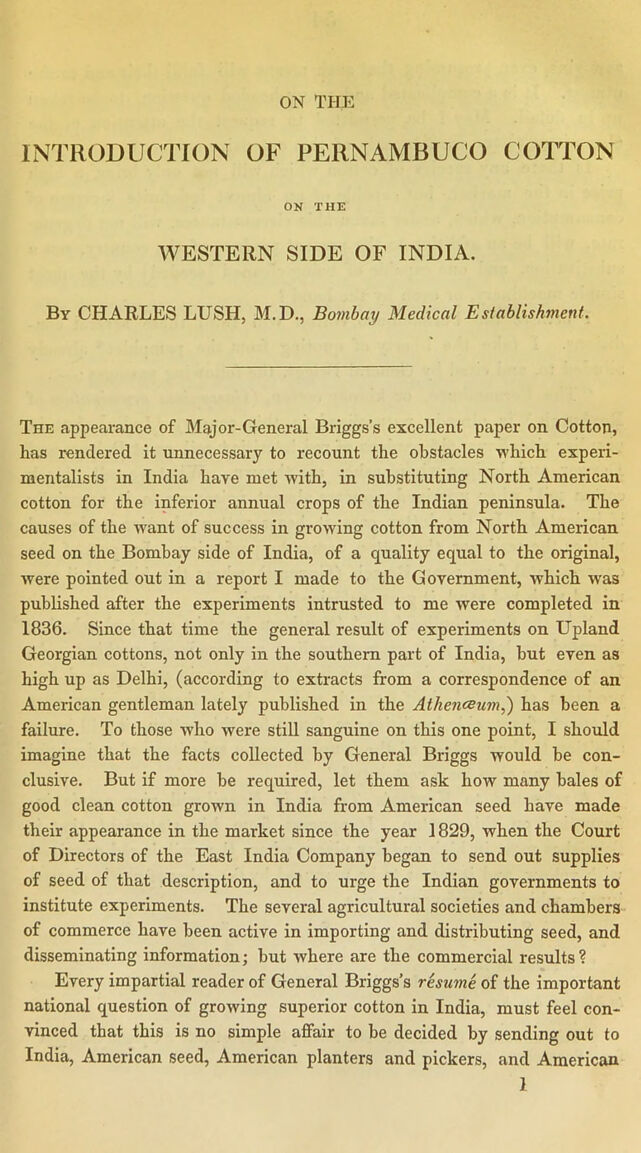
![saw-gins, even presuming that such means will fulfil their end to the utmost. It is a complicated and many-headed question, to he taken up in detail. May I be permitted to request the attention of the Committee to one fraction only of this extensive subject? Is there any species of cotton which will ncvt only bring a high price in the market, hut capable of an almost indefinite increase of consumption, which, under favourable circumstances, will not degene- rate, will be an addition to the present produce of the country, not a substitution, and one capable of being cleaned [seeded] by the most simple machinery, or even by the hand ? I believe the Pernambuco cotton will fulfil these several con- ditions. I take the liberty of quoting from the pamphlet* * * § already alluded to, and cited by General Briggs, the following passages:— “The Pernambuco, or kidney cotton, {Gossypium acuminatum of Roxburgh,) is already naturalized in this country [India], but in peculiar situations, old gardens of red lateritic t soil, as at Belgara and Darwar, and hedges where ashes are thrown. What we call ‘ black cotton soil,’ when unmixed, appears almost poisonous to it, especially if irrigated. In the latter case it bears rotten abortive pods, and neither the seed nor the cotton comes to perfection. In part of the experimental farm near Broach (Guzerat), where the black soil was mixed with red sand, it grew sufiiciently well. “ At the Seegeehullee farm ]; (Southern Maratha country), whether irrigated or left dry, it grew straggling and produced nothing. At Dapooree near Poona, in black soil, it has never ripened its seed, but produces shrivelled, half-formed pods. It is therefore clear that whenever favourable localities are found for this cotton, it will be an addition to the produce of the country, not a substitute of a doubtful and varying crop for a certainty§.” A reference to Kosteb’s Travels hi Brazil will give ample in- formation on this cotton. It appears from his statement that it fliourishes most in high and dry places where the soil is red or mixed with yellow, and it seems to be manured by the ashes of newly cleared jungle, which is its favourite site. * * * * * * Written in 183G. f For a description of Laterite, vide F. Buchanan’s (Hamilton) Journey to Mysore, See. Sec. $ Black soil. § This alludes to the unsuccessful attempts to substitute “ Upland Georgias” for “ Surats.”](https://iiif.wellcomecollection.org/image/b22390832_0006.jp2/full/800%2C/0/default.jpg)