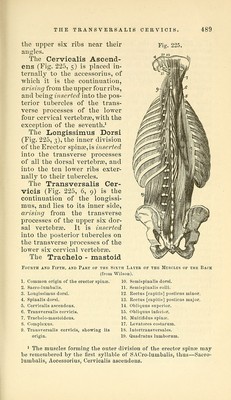
Practical anatomy: a manual of dissections / by Christopher Heath.
- Christopher Heath
- Date:
- 1870
Licence: Public Domain Mark
Credit: Practical anatomy: a manual of dissections / by Christopher Heath. Source: Wellcome Collection.
Provider: This material has been provided by the Francis A. Countway Library of Medicine, through the Medical Heritage Library. The original may be consulted at the Francis A. Countway Library of Medicine, Harvard Medical School.
459/600 (page 449)
![which is generally' closed, but during the process of de- glutition is opened by the action of the circumflexus [ten- sor] palati muscle, and thus the equilibrium of the air in the tj-mpanum is maintained. The palate is to be drawn up so as to put the pillars of the fauces ou the stretch as much as possible, and the raucous membrane is to be removed to expose the palato-glossus and palato-pharyngeus muscles. The Palato-glossus is placed in front of the tonsil and is very small and indistinct. The muscle arises from the middle line of the soft palate in common with its fellow, and descends to the side of the tongue, where it is inserted^ joining the fibres of the st3-lo-glossus and byo-giossus muscles. The Palato-pharyngeus (Fig. 205, 9) is larger than the palato-glossus, and is placed behind the tonsil. It arises in the palate by two slips which are separated b3' the leva- tor palati muscle, and the fibres of which meet those of the opposite muscle in the median line. The muscle passes obliquely downwards to the pharj^ix to be iriserted into the posterior border of the th3a'oid cartilage with the st^do-pharyngeus, and to be lost in the wall of the pharynx itself. The palato-glossus muscle is the constrictor of the fauces and grasps the bolus of food when it has passed out of the mouth, thus preventing its return. Both it and the palato-pharyngeus are suijplied by branches from Meckel's ganglion. The Amygdala or Tonsil is placed between the palato- glossus and palato-pharyngeus muscles and is usually much shrunken after death. It consists of a number of mucous follicles collected together, the orifices of which ma}^ be seen on the internal surface. The outside of the tonsil is in close relation with the superior constrictor of the phar^aix and with the ascending pharyngeal artery. It is to be noticed that it is anatomically impossible for any enlargement of the tonsil to obstruct the Eustachian tube and thus produce deafness. [Externally the tonsil cor- responds about to the angle of the lower jaw.] The tongue and the larynx are to be detached by dividing all the structures between them and the palate, and are to be carefully pre- served for subsequent examhiation. By inverting the skull the hard palate will then be brought into view. 38*](https://iiif.wellcomecollection.org/image/b21057679_0459.jp2/full/800%2C/0/default.jpg)