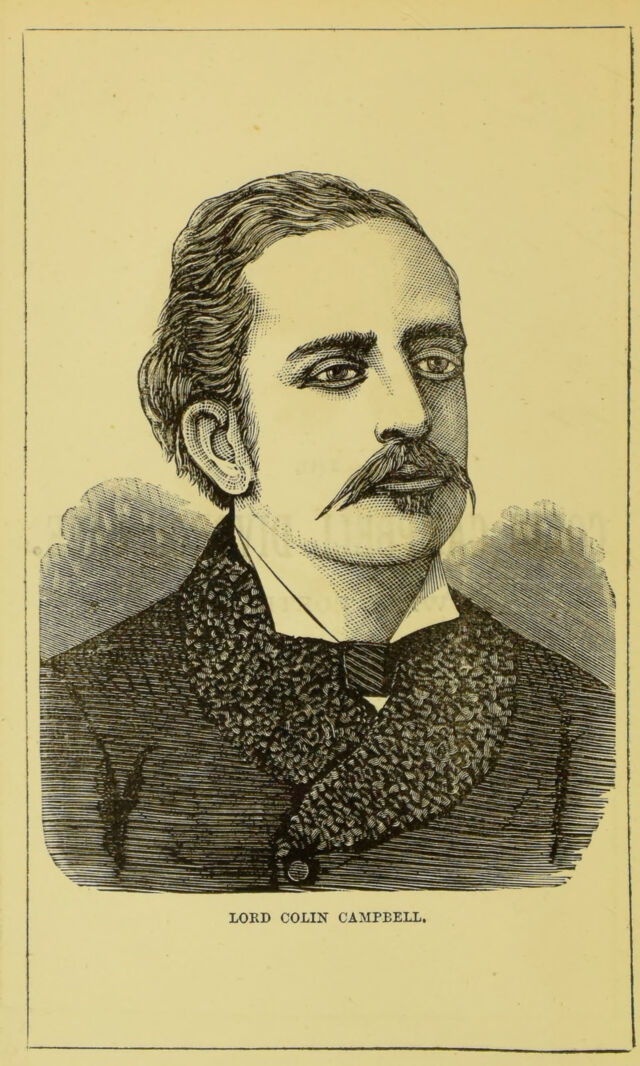
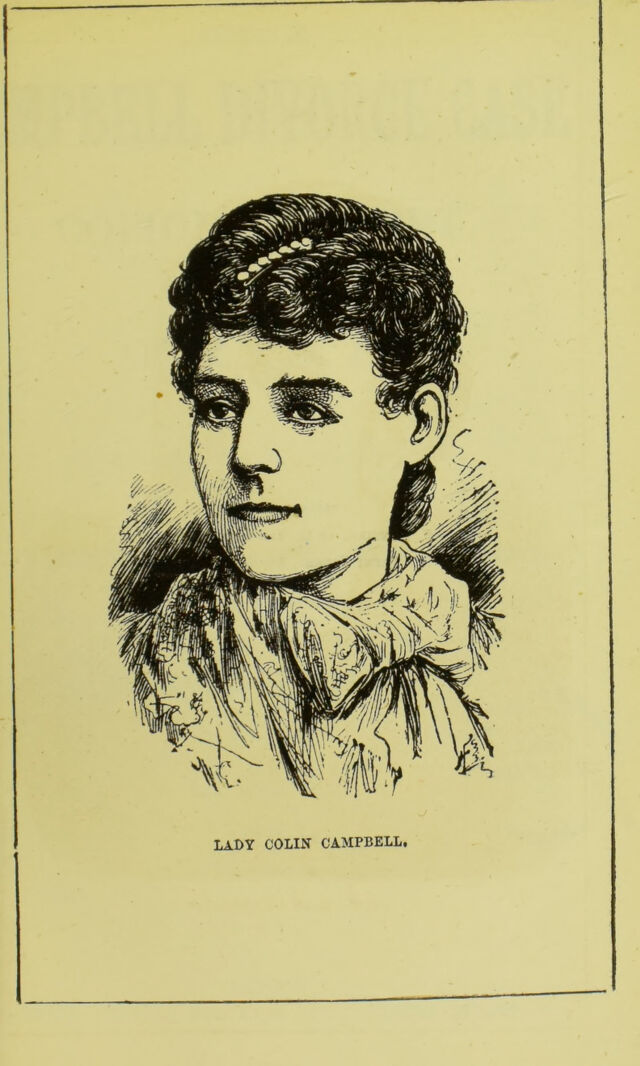
The Campbell divorce case : copious report of the trial / With numerous portraits of those concerned drawn from life by Harold Furniss.
- Date:
- 1887
Licence: Public Domain Mark
Credit: The Campbell divorce case : copious report of the trial / With numerous portraits of those concerned drawn from life by Harold Furniss. Source: Wellcome Collection.
Provider: This material has been provided by Royal College of Physicians, London. The original may be consulted at Royal College of Physicians, London.
35/160
![danger there was to Lord Colin, the imminent danger there was to him if I appeared. And you say in the letter, in reference to the proceedings, “ which you know ], with all my heart, disapprove of ?”—I meant to inform him how sorry I should be to have to appear. Then why did you not, writing in these confidential terms, tell him the reason in your letter ?—I thought he would understand. He ought to have understood what I meant by that; but when he addressed me again, I was obliged to say what I disliked to put in the letter. The next letter you addressed to Lord Colin was about a fortnight after, and it is addressed, “ My dearest Coco,” and you speak of that “ odious and most unfair stance.” Then you write another letter, in which you say, “I cannot remember every conversation that took place between us, ana if Mrs Blood spoxe to me on any subject, I have no right to use her words against her daughter.” Was that an answer in respect to an applicat ion from Lord Colin that you should give evidence of some conversation?—I think you will find Lord Colin’s answer to that. Counsel on both sides agreed that there was no answer on the part of Lord Colin* . ell, what did Lord Colin’s letter ask you to do ?—It asked me in regard to what Mrs. Blood said about her daughter to me. Was that with a view to j'our giving evidence in this case ?—No; I did not know what he intended to do with my private letters. These letters were written in perfect friendship to Lord Colin. I kept no copies of my letters. Then you opened a fresh correspondence with Lord Colin in August, 1882, and in one of your letters you say, “ If I were you I would get rid of her by letting her divorce you, if you could not divorce her.” What did you mean by saying that?-I referred to the story of Mary Watson in regard to him. I did not believe that Lord Colin could get a divorce from his wife, because he had tried to find out something against her, but could not do so, You say. also, that that would be less bad than being tied to her for life,” and that lie “ could get a nice little woman who would be a real companion to him.” \\ hat did you mean to suggest by that ?—I meant that it would be better for him to be a divorced man and free, than to be in the position he was. I thought his qualities were very domestic, and that if he married again he would be much happier than living in the position in which he then was; but that he could not marry if he were bound to the petitioner. What did you mean to suggest Lord Colin should do ?—Put me in a position to help him. I thought Lady Colin might get a divorce from him On August 12 Lord Colin wrote to you saying lie “did not quite under- stand your suggestion,” and asking you to let him know “ exactly how the case stood.” In your answer you say “ G.” (Lady Colin) would never give him a chance of divorcing her, and as they were bot* young it would be b tter to be free of each other—as these matters died out in a short time— than to bear the unsupportable dragging chain of their marriage. What did you mean by that ? I want a plain answer to a very plain question., What did you mean by suggesting that Lady Colin should' be put in a posi- tion to divorce her husband?—In regard to Lord Colin I meant that if I was to tell the story of Mary Watson it would go against him in a suit for](https://iiif.wellcomecollection.org/image/b28405134_0037.jp2/full/800%2C/0/default.jpg)