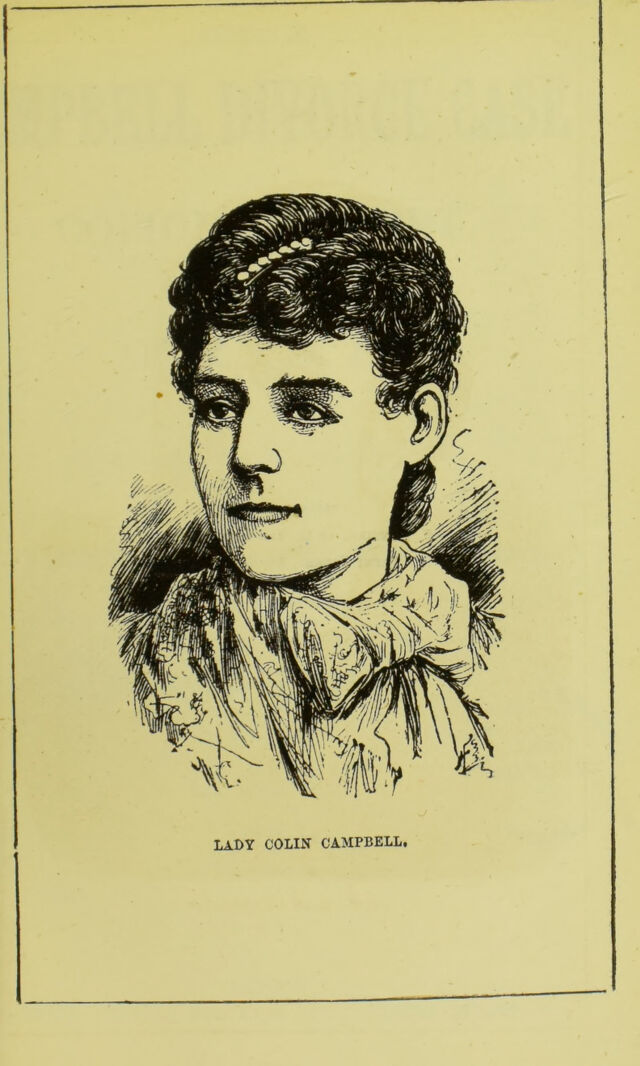
The Campbell divorce case : copious report of the trial / With numerous portraits of those concerned drawn from life by Harold Furniss.
- Date:
- 1887
Licence: Public Domain Mark
Credit: The Campbell divorce case : copious report of the trial / With numerous portraits of those concerned drawn from life by Harold Furniss. Source: Wellcome Collection.
Provider: This material has been provided by Royal College of Physicians, London. The original may be consulted at Royal College of Physicians, London.
51/160
![■which has been put forward. We are not left without light to guide us in -this part of the case. We have had not only the evidence of La-ty Mih s, but we have had the evidence of letters written by her, which on this point made it impossible for her to deviate from what was the fact. I am not going to weary you by reading these letters through again, but I desire to call your attention to one or two salient passages in them. I daresay the passage about the Duke of Argyll's views on the Deluge received more .attention in Court than the more important issues we had to try. On the 7th of August, Lady Miles wrote to Lord Colin a letter, which was put in by Sir C. Russell. Lady Miles said, in the course of her cross-examination, ■among the many other clever things to which she gave utterance, and which naturally enough carried the gallery with her, that ladies’ letters ought to be kept sacred. She said, “ I thought I was writing to a man of honour, and nottoLoid Colin Campbell.” Lady Miles, with her great ability—’ ■and I am painfully sensible of it — does not quite understand legal procedure. These letters, I need hardly say, Lord Colin had been compelled to disclose to Mr. George Lewis, because he is re- quired by law to make an affidavit as to what letters he had in his possession, or ever had had in his possession, as to this case. The letters were presented to Mr. Lewis, and Lady Miles forgot that they were put in evidence not by us, but by her own side—by Lady Colin’s connsel. It was my friend, Mr. Inderwick, aided by Sir C Russell, who put all these letters in evidence, and spent the greater part of Friday afternoon in ■reading them, and then Lady Miles, with her quickness or her imperfect appreciation of fact, turns round and says that Lord Colin is not a man of honour because he has brought into Court a lady’s letters. [At this point the Duke of Argyll entered the Court, and Lord Colin made place for him beside himself.] Then it is said that a letter is not forthcoming addressed to Lord Colin relating to this matter of Amelia Watson. This letter Lord •Colin never received. The letter I am going to read is dated the 7th August L8K3, the time at which this charge, recollect, was being made—a lettei written by Lady Miles, the cousin, friend, and confida?ite of Lady Colin, t< Lord Colin, upon charges which had been put forward for the first time. This is the letter:—“Now, what on eaith could make her bring those ■charges founded on falsehood and perjury? - It is very dreadful. She could not prove cruelty on your part. Few husbands gave their wives the indulgence and liberty you gave her.” Then follows, gentlemen, a line which is tom away, and then Lady Miles goes on to say :—“ Of course, my dear Colin, any letter you wrote to me must sink into the silence of my heart.” So far that would be open to the ingenious explanation which my learned friend,Sir Charles Russell,tried to put upon it by saying that it merely irelated to the idea of a charge of cruelty in the ordinary sense of the term of beating, kicking, and swearing. 'But the passage which follows destroys any comfort which the learned Counsel by any possibility could derive fiom that theory. “ I could not but loathe the present proceedings ■against you. Any honest woman could but shrink from the course this family is taking.’ Lady Miles writes this, having been associated with Lady Colin on the most intimate terms, and with a fuller knowledge t an any human being could possess upon it. “ Has Blandford anything to do with it ?” That is not an answer to a question by Lord Colin, as Lady Miles cleverly tried to suggest. It is a question put by herself a sugges- tion of her own : and what do you think was working in her mind when she wrote it ? Why the very point which I have been putting to you, that 'this was a charge put forward in consequence of the suspicions of 'infidelity](https://iiif.wellcomecollection.org/image/b28405134_0053.jp2/full/800%2C/0/default.jpg)