On peculiar appearances exhibited by blood-corpuscles under the influence of solutions of magenta and tannin / by William Roberts, M.D.
- William Roberts
- Date:
- [1863]
Licence: Public Domain Mark
Credit: On peculiar appearances exhibited by blood-corpuscles under the influence of solutions of magenta and tannin / by William Roberts, M.D. Source: Wellcome Collection.
Provider: This material has been provided by The University of Glasgow Library. The original may be consulted at The University of Glasgow Library.
3/12
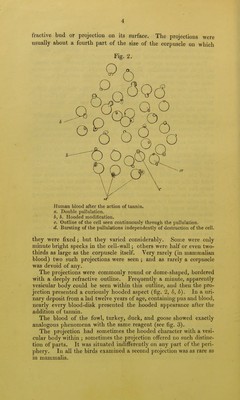
![[ JVom the Pbooeebings of the Royal Society, March 19, 1863.] On Peculiar. Appearances exhibited by Blood-corpuscles under tlie influence of Solutions of Magenta and Tannin. By William Robeiits, M.D., Physician to the Manchester Royal Infirmary. The object of the following paper is to give an account of certain ' observations which seem to indicate that the cell-wall of the verte- brate blood-disk, does not possess the simplicity of structure usually attributed to it. . It is well known that the blood-corpuscles, vfhen floating in their own serum, or after having been treated with acetic acid or water, appear to be furnished with perfectly plain envelopes, composed of a simple homogeneous membrane, without distinction of parts. But, as will appear from the observations here to be related, when the blood is treated with a solution of magenta (nitrate of rosanilin) or with a dilute solution of tannin, the corpuscles present changes which seem irreconcileable with such a supposition. Attention is first asked to the effects of magenta. When a speck of human blood was placed on a glass slide and mixed with a drop of a watery solution of magenta*, the following changes were ob- served. The blood-disks speedily lost their natural opacity and yellow colour; they became perfectly transparent, and assumed a faint rose colour ; they also expanded sensibly, and lost their bicon- cave figure. In addition, a dark-red speck made its appearance on some portion of their periphery. The pale corpuscles took the colour much more strongly than the red; and their nuclei were displayed with great clearness, dyed of a magnificent carbuncle-red. Many of the nuclei were seen in the process of division, more or less ad- vanced ; and in some cells the partition had resulted in the produc- tion of two, three, or even four distinct secondary nuclei. These appearances were first observed in freshly-drawn blood from the finger. Subsequently blood from the horse, pig, ox, sheep, deer, camel, cat, rabbit, and kangaroo was examined in like manner. The effect on the red corpuscles (to which all the observations hereinafter recorded are exclusively confined) was in each instance the same as in human blood. The nucleated blood-disks of the oviparous classes, when treated similarly, yielded analogous results. The coloured contents were forthwith discharged ; the central nucleus came fully into view, and assumed a deep-red colour; the corpuscles expanded, they lost * The solution I found to .answer best in these experiments was a nearly satu- rated solution of nitrate of rosanilin, made by boiling the salt in water, and filtering after it had stood twenty-four hours, then diluting slightly with water to prevent precipitation.](https://iiif.wellcomecollection.org/image/b21479884_0003.jp2/full/800%2C/0/default.jpg)