On peculiar appearances exhibited by blood-corpuscles under the influence of solutions of magenta and tannin / by William Roberts, M.D.
- William Roberts
- Date:
- [1863]
Licence: Public Domain Mark
Credit: On peculiar appearances exhibited by blood-corpuscles under the influence of solutions of magenta and tannin / by William Roberts, M.D. Source: Wellcome Collection.
Provider: This material has been provided by The University of Glasgow Library. The original may be consulted at The University of Glasgow Library.
4/12 page 2
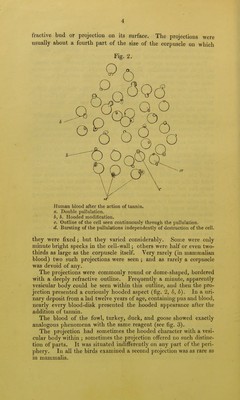
![something of their oval form, and approached nearly, or sometimes quite, to a circular outline. Lastly, there a])peared on the periphery a dark-red macula, of a character and position resembling that seen on the mammalian blood-disk. Such a macula was detected in the fowl, in the frog, and in the dace and minnow. Owing, however, to the large quantity of molecular matter floating in the serum, and which was coloured by the magenta, difficulties were found in preparing specimens which carried conviction that the macula in question was not an adhering granule. It was also found that it required a nice adjustment of the relative quantities of the solution and of the blood to bring it out. It was only when the right proportions were hit, and especially when the disks were made to roll over in the field of the microscope, that the existence of a coloured particle organically connected with the cell-wall could be satisfactorily made out. The best specimens were prepared from human blood drawn in the fasting condition, and from the blood of a kitten two days old. From well-prepared specimens of human blood the following par- ticulars were gathered (see fig. 1) :—Nearly every disk possessed the parietal macula ; it could be distinctly recognized in nine-tenths of them ; and in several of those in which it was not at first visible, it came into view as the corpuscles revolved in the field. Fig. 1. A. Human blood. B. Fowl's blood treated with magenta. The macula was clearly situated in the cell-wall, and not in the interior of the corpuscle. Usually it appeared as if imbedded or set in the rim of the disk, like the jewel in a diamond ring; but some- times it occupied various positions on the flat surfaces, and when so placed, the spot was difficult or impossible to detect. It commonly presented a thickly lenticular shape ; sometimes it was square, and occasionally in appearance vesicular (fig. 1, A, a). In some instances, and especially in long-kept specimens, the particle was seen to stand out on the outline of the disk like an excrescence. Still more rarely, instead of a spot, a thick red Une ran round the circumference for a quarter or a third of its extent (fig. 1, A, b). As a rule it was extremely minute, covering generally not more](https://iiif.wellcomecollection.org/image/b21479884_0004.jp2/full/800%2C/0/default.jpg)