Report on the air of Glasgow : with tables of wind, temperature, and rain-fall, for the month of July, 1877 / by E.M. Dixon in co-operation with the Medical Officer of Health.
- Glasgow (Scotland). Sanitary Department
- Date:
- 1877
Licence: Public Domain Mark
Credit: Report on the air of Glasgow : with tables of wind, temperature, and rain-fall, for the month of July, 1877 / by E.M. Dixon in co-operation with the Medical Officer of Health. Source: Wellcome Collection.
Provider: This material has been provided by The Royal College of Surgeons of England. The original may be consulted at The Royal College of Surgeons of England.
4/12 page 4
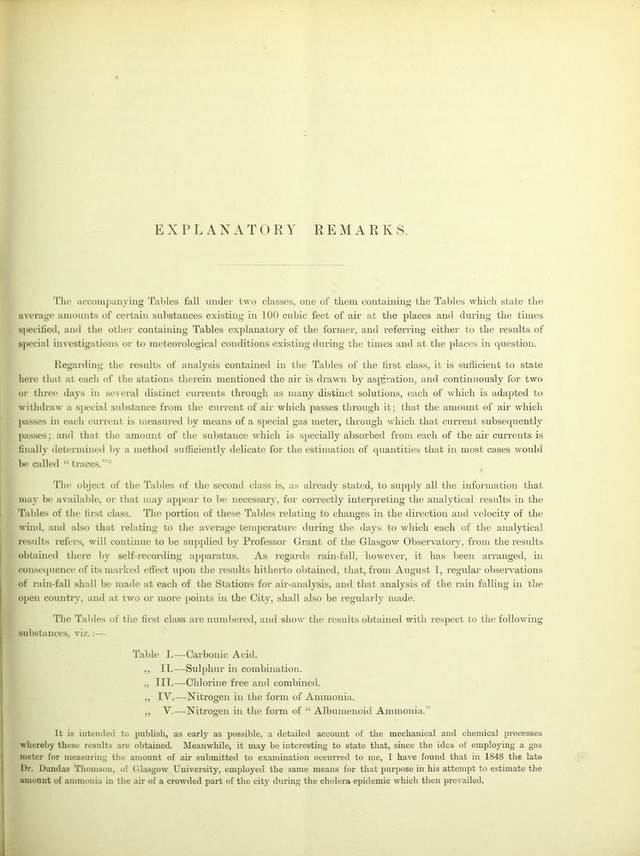
![Unless the ojjposite is expressly mentioned, all the nmnerical and other statements in the Tables must be understood to refer, not exclusively to the day indicated by the corresponding date, but to tlie interval between noon of that daj^ and noon of the day indicated by the date immediately preceding. The amounts of the various substances estimated in 100 cubic feet of air are in all cases, except that of carbonic acid, expressed in units of weight. The unit employed is the milligramme. In the case of carbonic acid the usual method of expressing the amount as so many volumes in 10,000 volumes of air has been followed. The “ dashes” in the Tal)les indicate experiments lost through known causes. The “ marks of interrogation,” on the other hand, indicate results departing so far from the normal character as to be clearly erroneoiis, while it is impossible to state Avith certainty the cause of error. Rain-fall is exjiressed in inches, the velocity of the Avind in miles j)er hour, and teiuperatui-e in Fahrenheit degrees. Tlie accompanying iMap of GlasgOAv Avill, it is hoped, also contribute materially to the interpretation of the results of analysis. In it the relatiA'^e density of shading corresponds approximately Avith the density of the population, and the black j^atclies indicate the sites of manufacturing establishments, from Avhich proceed large quantities of smoke or of noxious A'apours. The ])ositions of the Stations referred to in the Tables are indicated upon the Map by special marks, and the localities in Avhich these Stations are situated are named beloAv. These names are employed in the Tables to desigirate the respecth'e Stations. With respect to the Eaglesham Station, Avhicli Avill appear in these Tables from August 1, it is to l)e explained that it is situated at a distance of about 3 miles to the south of the A’illage of that name, and aboiit 12 miles in the same direction from Glasgow. It stands at an altitude of 997'5 feet aboA’e sea-level, upon the northern slope of the extended range of trap hills Avhich forms to some extent a boundaiy to the counties of Ayr, RenfreAv, and Lanark. The locality is so remote from manufacturing and even agricultural operations that the air and rain to be obtained there may be fairly accepted as standards AvhereAvith to compare the aii' and rain of GlasgOAV. It Avill also be used for some special investigations regarding ozone and other constituents of the atmosphere. Glas(JOW, 'IT-tth July, 1877.](https://iiif.wellcomecollection.org/image/b22324938_0006.jp2/full/800%2C/0/default.jpg)