Licence: Public Domain Mark
Credit: Diseases of the nose and nasopharynx. Source: Wellcome Collection.
Provider: This material has been provided by Royal College of Physicians, London. The original may be consulted at Royal College of Physicians, London.
151/164 (page 147)
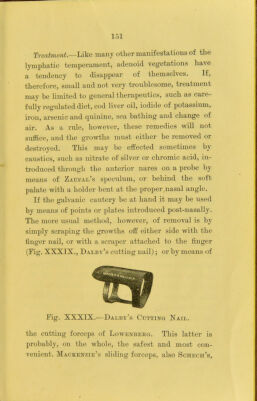
![quinine, or arsenic, or syrup of tlie liyperphospliites are likely to be beneficial. Beverley Robinson recommends cub^bs, sulphur and ammoniacum. The former may be administered in tincture, with equal parts of tincture of orange (Mackenzie), while sulphur may be conveniently prescribed under the form of Harrogate waters. The local treatment is equally important. The first indication is to remove the inspissated mucus and to cleanse the pharynx thoroughly by sprays and syringing, both anteriorly and posteriorly. A good lotion for this purpose is Dobell's, composed of borax (3]*), glycerine of carbolic acid (5]'), soda bicarb. (53), aquee (oss.) It may be necessary in order to thoroughly cleanse the mucous membrane to use wadding or a brush passed behind the soft palate. Retro-nasal gargles—that is passing the fluid from the throat through the nasal fossse— will be found useful. After the parts have been thoroughly cleansed I generally use powdered borax for insufflation, but persulphate of iron (one part to three of starch) and eucalyptus (one of the gum to two of starch) are also recommended by Mackenzie. The diet should be light and unirritating^ and alcohohc drinks should be entirely abstained from. Occasionally change of air, especially to the seaside, is beneficial. The subjects of post-nasal catarrh when travelling, or otherwise much exposed to dust or irritating vapours, should wear either respirators or some form of nasal plug.](https://iiif.wellcomecollection.org/image/b23982688_0151.jp2/full/800%2C/0/default.jpg)