Volume 1
Athenae Oxonienses : An exact history of all the writers and bishops who have had their education in the University of Oxford. To which are added the fasti, or annals of the said University / By Anthony A. Wood.
- Anthony Wood
- Date:
- 1813-20
Licence: Public Domain Mark
Credit: Athenae Oxonienses : An exact history of all the writers and bishops who have had their education in the University of Oxford. To which are added the fasti, or annals of the said University / By Anthony A. Wood. Source: Wellcome Collection.
Provider: This material has been provided by Royal College of Physicians, London. The original may be consulted at Royal College of Physicians, London.
531/600
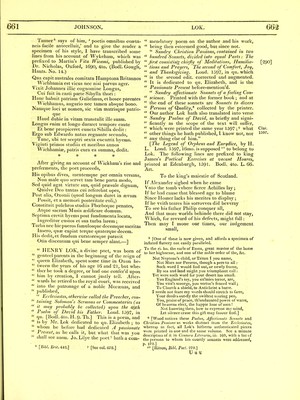
![Tanner* says of him, ' poetis omnibus coaeta- neis facile anlecelluit/ and to give the reader a specimen of his style, I have transcribed some lines from his account of Wykeham, which was prefixed to Martin's Vita Wkami, published by Dr. Nicholas, Oxford, I690, 4to. (Bodl. Gough, Hants. No. 14.) Qua capitaustrales comitatu HamptonaBritannos Wichhamia est vicus nec nisi parvus ager. Vixit Johannes illic cognomine Longus, Cui fuit in casti parte Sibylla thori : H anc habuit patriam Gulielmus, el hosce parentes Wichhamus, augurio nec tamen absque bono. Namque loci ut nomen, sic vim matrisque patris- que Haud dubie in vitam transtulit ille suam. Longus enim ut longo duraret tempore caute Et bene prospiceret cuncta Sibilla dedit: Ergo sub Edwardo nalus regnante secundo. Tunc, ubi ter sceptri sexta cucurrit hvems. Viginti primos studiis et moribus annos Wichhamise, patris cura ea summa, dedit. ^ ^ ^ ^ After giving an account of Wickham's rise and preferments, the poet proceeds. His opibus dives, mentemque per omnia versans, Non male quo servet tarn bene parta modo, Sed quid agat virtute sua, quid praesule dignum, Quidve Deo tantas cui referebat opes. Post alia, Oxonii (quod longum duret in tevum Possit, et a raemori posteritate coli,) Constituit pulchros studiis Phoeboque penates, Atque sacram Musis sedificare domum. Septima crevit hyems post fundamenta locata, ingreditur custos et sua turba larem ; Turba nec hicpueros famulosque decemque sacritas Insero, quae capiat terque quaterque decem. His dedit,et fundum curatoresque paravit Otia discentum qui bene semper alant.—] HENRY LOK, a divine poet, was born of genteel parents in the beginning of the reign of queen Elizabeth, spent some time in Oxon be- tween the years of his age I6 and 21, but whe- ther he took a degree, or had one confer'd upon him by creation, 1 cannot justly tell. After- wards he retired to the royal court, was received into the patronage of a noble Mecajuas, and published, Ecc/esiastes, otherzcise called the Preacher, coti- tahiing Solomoiis Sermons or Commentaries (as it may probably be collected) upon the 4Qth Psalm of David his Father. Lond. 1597, in qu. [Bodl.4to. H. 9. Th.] This is a poem, and is by Mr. Lok dedicated to qu. Elizabeth ; to whom he before had dedicated A passionate Present, as he calls it, but what that was you shall see anon. Jo. Lilye the poet' hatha com- « [Bibl. Brit. 442.] 7 [See col. 678.] mendatory poem on the author and his work, being then esteemed good, but since not. Sundri/ Christian Passions, contained in two hundred Sonnets, divided into equal Parts : The Jirst consistin'g chiejlij of Meditations, Humilia- [290] tions and Prayers, The second of Comfort, Joy, and Thanksgiving. Lond. 1597, in qu, which is the second edit, corrected and augmented. It is dedicated to qu. Elizabeth, and is the Passionate Present before-mention'd. Sutidry affectionate Sonnets of a feeling Con- science. Printed with the former book; and at the end of these sonnets are Sonnets to divers Persons of Quality,^ collected by the printer. Our author Lok hath also translated into verse Sundry Psalms of David, as briefly and signi- ficantly as the scope of the text will suffer, which were printed the same year 1597 ;^ what Clar. other things he hath published, I know not, nor any thing else of him. [The Legend of Orpheus and Ettrydice, by H. L. Lond. 1597, l6mo. is supposed '° to belong to Lok. The following lines are prefixed to king James's Poetical Exercises at vacant Houres, printed at Edenburgh, 1591. Bodl. 4to. L. 66. Art. To the king's maiestie of Scotland. If Alexander sighed when he came Vnlo the tomb where fierce Achilles lay; If he had cause that blessed age to blame Since Homer lacks his merites to display; If he with teares his sorrovves did bewray To see his father Philip conquer all. And that more worlds behinde there did not stay, Which, for reward of his defects, might fall: Then may I mone our times, our iudgement small, * [One of these is now given, and affords a specimen of inHated flattery not easily paralleled. To the ri. ho. the earle of Essex, great master of the horse to her highiiesse, and one of the noble order of the, &c. Not Neptune's child, or Triton I you name, Not Mars nor Perseus, though a pere to all : Such word I would find out, or newly frame, By sea and land might you triumphant call: Yet were such word for your desert too small. You England's ioy, you en'mies terror, are, You vice's scourge, you vertue's fenced wall; To Church a shield, to Antichrist a barre. I neede not feare my words should stretch to farre, Your deedf s out-fly the swiftest soaring pen. You, praise of peace, th'undaunted powre of warre, Of heauens elect, the happie loue of men ! Not knowing then, how to expresse my mind, Let silence craue this gift may fauour find.] ' [Wood notices these Psalms, Affectionate Sonnets and C/iristian Fossions as works distinct from tiie Ecclesiastes, whereas n\ fact, all Lok's hitherto authenticated pieces were printed in one and the same volume. See a minute description of it in Ccnsura hitei'uria, iii. 169, with a list of the persons to whom his courtly sonnets were addressed, p. 170.] «° [liitson, Bibl. Poet. 270.] U U a](https://iiif.wellcomecollection.org/image/b24751236_0001_0535.jp2/full/800%2C/0/default.jpg)