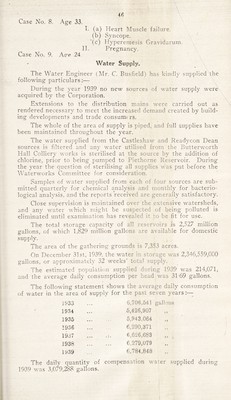
[Report 1939] / Medical Officer of Health, Oldham County Borough.
- Oldham (England). County Borough Council. nb2004302054.
- Date:
- 1939
Licence: Attribution 4.0 International (CC BY 4.0)
Credit: [Report 1939] / Medical Officer of Health, Oldham County Borough. Source: Wellcome Collection.
42/92 page 49
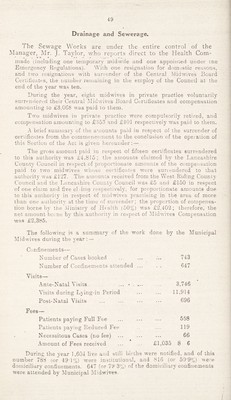
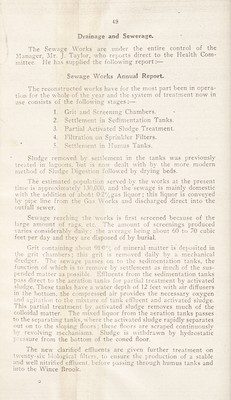
![Drainage and Sewerage. The Sewage Works are under the entire control of the Manager, Mr. J. Taylor, who reports direct to the Health Com¬ mittee. He has supplied the following report:— Sewage Works Annual Report. The reconstructed works have for the most part been in opera¬ tion for the whole of the year and the system of treatment now in use consists of the following stages:— 1. Grit and Screening Chambers. 2. Settlement in Sedimentation Tanks. 3. Partial Activated Sludge Treatment. 4. Filtration on Sprinkler Filters. 5. Settlement in Humus Tanks. Sludge removed by settlement in the tanks was previously treated in lagoons, 'but is now dealt with by the more modern method of Sludge Digestion followed by drying beds. The estimated population served by the works at the present time is approximately 130,000, and the sewage is mainly domestic with the addition of abofit 0'2%gas liquor; this liquor is conveyed by pipe line from the Gas Y\ orks and discharged direct into the outfall sewer. Sewage reaching the works is first screened because of the large amount of rags, etc. The amount of screenings produced varies considerablv dailv; the average being about 60 to 70 cubic feet per day and they are disposed of by burial. Grit containing about 91-0% of mineral matter is deposited in the grit chambers; this grit is removed daily by a mechanical dredger. The sewage passes on to the sedimentation tanks, the function of which is to remove by settlement as much of the sus¬ pended matter as possible. Effluents from the sedimentation tanks pass direct to the aeration tanks for partial treatment by activated sludge. These tanks have a water depth of 12 feet with air diffusers in the bottom, the compressed air provides the necessary oxygen and agitation to the mixture of tank effluent and activated sludge. 1 his partial treatment by activated sludge removes much of the colloidal matter. The mixed liquor from the aeration tanks passes to the separating tanks, where the activated sludge rapidly separates out on to the sloping floors; these floors are scraped continuously by revolving mechanisms. Sludge is withdrawn by hydrostatic ] assure from the bottom of the coned floor. The new clarified effluents are given further treatment on twenty-six biological filters, to ensure the. production of a stable and well nitrified effluent, before passing through humus tanks and into the Wince Brook.](https://iiif.wellcomecollection.org/image/b29937127_0042.jp2/full/800%2C/0/default.jpg)