History of medicine : Syllabus and specimen extracts.
- John Comrie
- Date:
- [between 1900 and 1999]
Licence: Attribution-NonCommercial 4.0 International (CC BY-NC 4.0)
Credit: History of medicine : Syllabus and specimen extracts. Source: Wellcome Collection.
Provider: This material has been provided by the Harvey Cushing/John Hay Whitney Medical Library at Yale University, through the Medical Heritage Library. The original may be consulted at the Harvey Cushing/John Hay Whitney Medical Library at Yale University.
15/52 page 3
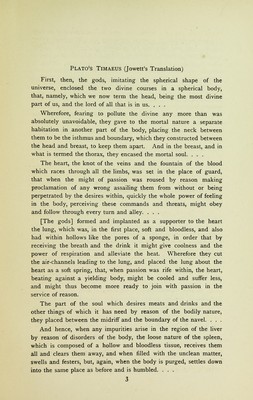
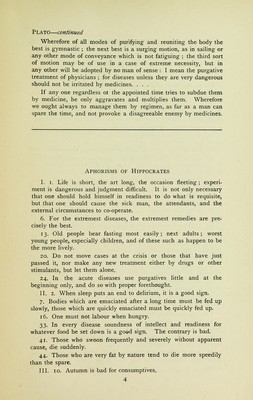
![PLATO'S Timaeus (Jowett's Translation) First, then, the gods, imitating the spherical shape of the universe, enclosed the two divine courses in a spherical body, that, namely, which we now term the head, being the most divine part of us, and the lord of all that is in us. . . . Wherefore, fearing to pollute the divine any more than was absolutely unavoidable, they gave to the mortal nature a separate habitation in another part of the body, placing the neck between them to be the isthmus and boundary, which they constructed between the head and breast, to keep them apart. And in the breast, and in what is termed the thorax, they encased the mortal soul. . . . The heart, the knot of the veins and the fountain of the blood which races through all the limbs, was set in the place of guard, that when the might of passion was roused by reason making proclamation of any wrong assailing them from without or being perpetrated by the desires within, quickly the whole power of feeling in the body, perceiving these commands and threats, might obey and follow through every turn and alley. . . . [The gods] formed and implanted as a supporter to the heart the lung, which was, in the first place, soft and bloodless, and also had within hollows like the pores of a sponge, in order that by receiving the breath and the drink it might give coolness and the power of respiration and alleviate the heat. Wherefore they cut the air-channels leading to the lung, and placed the lung about the heart as a soft spring, that, when passion was rife within, the heart, beating against a yielding body, might be cooled and suffer less, and might thus become more ready to join with passion in the service of reason. The part of the soul which desires meats and drinks and the other things of which it has need by reason of the bodily nature, they placed between the midriff and the boundary of the navel. . . . And hence, when any impurities arise in the region of the liver by reason of disorders of the body, the loose nature of the spleen, which is composed of a hollow and bloodless tissue, receives them all and clears them away, and when filled with the unclean matter, swells and festers, but, again, when the body is purged, settles down into the same place as before and is humbled. . . .](https://iiif.wellcomecollection.org/image/b21029052_0015.jp2/full/800%2C/0/default.jpg)
 No text description is available for this image
 No text description is available for this image
 No text description is available for this image