Surgery, a practical treatise with special reference to treatment / by C.W. Mansell Moullin ; assisted by various writers on special subjects.
- Mansell-Moullin, C. W. (Charles William), 1851-1940
- Date:
- 1893
Licence: Public Domain Mark
Credit: Surgery, a practical treatise with special reference to treatment / by C.W. Mansell Moullin ; assisted by various writers on special subjects. Source: Wellcome Collection.
Provider: This material has been provided by the Augustus C. Long Health Sciences Library at Columbia University and Columbia University Libraries/Information Services, through the Medical Heritage Library. The original may be consulted at the the Augustus C. Long Health Sciences Library at Columbia University and Columbia University.
101/1262 page 93
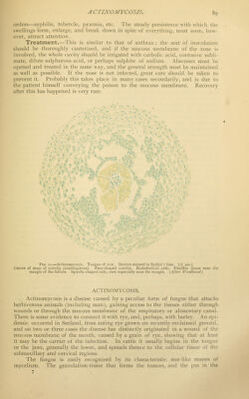
![inciiiiL'd to bleed. In most cases, however, the l)a(illi enter the celliihir tissue directly, either through inflammatory abrasions of the surface, as in eczema capitis and otorrhea, or in the case of mucous membranes, even without this. In the lungs it seems probable that they may develop Hrst in the epithelium that is heaped up in the alveoli in pulmonary catarrh. The dissemination is chiefly regulated by the anatomical structure 0/ t/ir part. The bacilli may spread slowly in the surrounding tissue, and the seat of infection enlarge continuously without involving other structures. They may be carried into the lym])hatics, and arrested for a time, or even permanently, in the glands. They may get into the blood-stream and rajjidly spread all over the pulmonary or systemic circulation ; the wall of a vein may be ruptured by some accident, or torn in some operation, or the tuberculous focus may gradually ulcerate through it and burst into the interior. The same thing may occur with one of the arteries, though much more rarely ; and finally, if the lining membrane of one of the serous or synovial cavities is attacked, the infection may spread rapidly over the whole surface. The presence of a viecJianical eiu/)o/us, although it may not be of so much importance as in the ca.se of pyogenic micrococci, when in all probability it deter- mines the formation of metastatic abscesses, is certainly of consequence in connec- tion with tubercular arthritis. It is not uncommon to find that this has originated from a wedge-shaped sequestrum in one of the articular ends of the bones ; and it is a fair suggestion that cutting off the circulation and lowering the vitality of the segment is of very considerable a.ssistance to the development of specific germs. As the action of jjyogenic organisms is materially assisted by t\\epresence of septic decomposition, the ptomaines formed by this soaking into the tissues, lower- ing their vitality, and rendering them less capable of resistance, so it is with tubercle-bacilli. If suppuration occurs in connection with a tuberculous cavity, the process of destruction becomes exceedingly rapid. On the one hand the pyogenic organisms grow with greatly increased vigor in the tissues that have been weakened by the tuberculous process; on the other, the risk of general dissemination is very greatly increased by the possibility of the walls of the ve.ssels giving way. Pathology.—Tubercle-bacilli, wherever they are implanted, at once set up chronic inflammation of a somewhat special character. The earlier changes are the same as with any non-pyogenic germ ; the capillaries dilate, more plasma pours through, and the leucocytes collect in larger numbers. Then, however, an enormous multinuclear cell develops at each point of infection, so peculiar in its appearance that for a long time it was believed to be a formation special to tuberculosis. The most typical tubercles are the youngest, those which are firm and gray, standing out from the tissues around as minute, but distinctly circumscribed, masses. Each of these is made up of smaller ones, containing in their centre a giant multinuclear cell, and sending out in all directions processes which branch and form a kind of network. In the meshes, round the central mass, lie other cells, known from their general appearance as epithelioid ; and these in their turn are surrounded by numbers of smaller ones, identical with ordinary leucocytes. In this, however, there is nothing peculiar but the regularity of the arrangement. Structures precisely similar may be produced by other causes than tubercle-bacilli; similar giant-cells can be found in any chronic inflammation, especially those forms which are poorly supplied with vessels ; and they are surrounded by similar groups of epithelioid and lymphoid corpuscles. The specific character is due to the tubercle-bacilli, which can be found in the central mass, and in and between the epithelioid cells. The semi-translucent, gray, non-vascular nodules formed in this Avay are typical of tuberculosis. Sometimes, in the infiltrating form of growth, they can- not be recognized in the masses of round-celled granulation-tissue thrown out as a](https://iiif.wellcomecollection.org/image/b21213744_0101.jp2/full/800%2C/0/default.jpg)
 No text description is available for this image
 No text description is available for this image
 No text description is available for this image