Surgery, a practical treatise with special reference to treatment / by C.W. Mansell Moullin ; assisted by various writers on special subjects.
- Mansell-Moullin, C. W. (Charles William), 1851-1940
- Date:
- 1893
Licence: Public Domain Mark
Credit: Surgery, a practical treatise with special reference to treatment / by C.W. Mansell Moullin ; assisted by various writers on special subjects. Source: Wellcome Collection.
Provider: This material has been provided by the Augustus C. Long Health Sciences Library at Columbia University and Columbia University Libraries/Information Services, through the Medical Heritage Library. The original may be consulted at the the Augustus C. Long Health Sciences Library at Columbia University and Columbia University.
97/1262 page 89
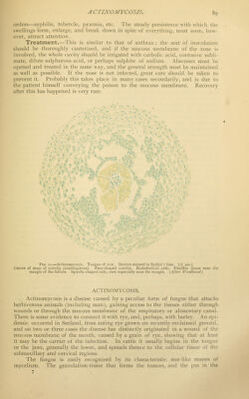
![orders—syphilis. tul)ercle, ijyoemia, etc. The steady persistence with which the swellings form, enlarge, and l)reak down in spite of everything, must soon, how- ever, attract attention. Treatment.—This is similar to that of anthrax; the seat of inoculation should be thoroughly cauterized, and if the mucous membrane of the nose is involved, the whole cavity should be irrigated with carbolic acid, corrosive subli- mate, dilute sulphurous acid, or perhaps sulphite of sodium. Absces.ses must be opened and treated in the same way, and the general strength must be maintained as well as po.ssible. If the nose is not infected, great care should be taken to ])revent it. Probably this takes place in many ca.ses secondarily, and is due to the patient himself conveying the poison to the mucous membrane. Recovery after this has happened is very rare. v:* Fig. 10.—Actinomycosis. Tongue of cow. Section stained in Spiller's blue. (X 300.) Centre of mass of conidia (conidiophore). Pear-shaped conidia. Endothelioid cells. Fibrillar tissue near the margin of the follicle. Spindle-shaped cells, seen especially near the margin. {After Woodhead.) ACTINOMYCOSIS. Actinomycosis is a disease caused by a peculiar form of fungus that attacks herbivorous animals (including man), gaining access to the tissues either through wounds or through the mucous membrane of the respiratory or alimentary canal. There is some evidence to connect it with rye, and, perhaps, with barley. An epi- demic occurred in Seeland, from eating rye grown on recently-reclaimed ground, and on two or three cases the disease has distinctly originated in a wound of the mucous membrane of the mouth, caused by a grain of rye, showing that at least it may be the carrier of the infection. In cattle it usually begins in the tongue or the jaws, generally the lower, and spreads thence to the cellular tissue of the submaxillary and cervical regions. The fungus is easily recognized by its characteristic star-like masses of mycelium. The granulation-tissue that forms the tumors, and the pus in the 7](https://iiif.wellcomecollection.org/image/b21213744_0097.jp2/full/800%2C/0/default.jpg)
 No text description is available for this image
 No text description is available for this image
 No text description is available for this image