On the relation of the chest-movements to prognosis in lung-disease : and on the application of stethometry to examinations for life assurance.
- Ransome, Arthur.
- Date:
- 1882
Licence: Public Domain Mark
Credit: On the relation of the chest-movements to prognosis in lung-disease : and on the application of stethometry to examinations for life assurance. Source: Wellcome Collection.
Provider: This material has been provided by the Harvey Cushing/John Hay Whitney Medical Library at Yale University, through the Medical Heritage Library. The original may be consulted at the Harvey Cushing/John Hay Whitney Medical Library at Yale University.
38/138 page 20
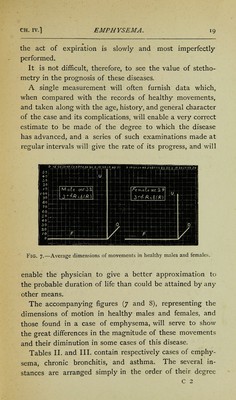
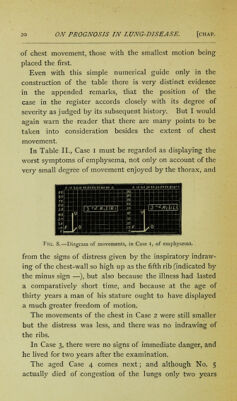
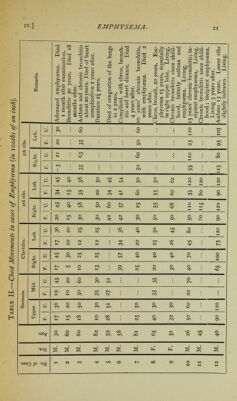
![of chest movement, those with the smallest motion being placed the first. Even with this simple numerical guide only in the construction of the table there is very distinct evidence in the appended remarks, that the position of the case in the register accords closely with its degree of severity as judged by its subsequent history. But I would again warn the reader that there are many points to be taken into consideration besides the extent of chest movement. In Table II., Case I must be regarded as displaying the worst symptoms of emphysema, not only on account of the very small degree of movement enjoyed by the thorax, and I JJMJ BSimJ WKt ruiriniruuiiii f : ■■■■IK1ZJCH3 fiflj IVf! »Kfttfr.Tr4jl |F|*]HMI. Hfl ME^I iirri ■ nW P*f*]| IH iBnnFj tm»JT ^^. Fig. 8.—Diagram of movements, in Case I, of emphysema. from the signs of distress given by the inspiratory indraw- ing of the chest-wall so high up as the fifth rib (indicated by the minus sign —), but also because the illness had lasted a comparatively short time, and because at the age of thirty years a man of his stature ought to have displayed a much greater freedom of motion. The movements of the chest in Case 2 were still smaller but the distress was less, and there was no indrawing of the ribs. In Case 3, there were no signs of immediate danger, and he lived for two years after the examination. The aged Case 4 comes next; and although No. 5 actually died of congestion of the lungs only two years](https://iiif.wellcomecollection.org/image/b2100710x_0038.jp2/full/800%2C/0/default.jpg)

 No text description is available for this image
 No text description is available for this image
 No text description is available for this image