On the relation of the chest-movements to prognosis in lung-disease : and on the application of stethometry to examinations for life assurance.
- Ransome, Arthur.
- Date:
- 1882
Licence: Public Domain Mark
Credit: On the relation of the chest-movements to prognosis in lung-disease : and on the application of stethometry to examinations for life assurance. Source: Wellcome Collection.
Provider: This material has been provided by the Harvey Cushing/John Hay Whitney Medical Library at Yale University, through the Medical Heritage Library. The original may be consulted at the Harvey Cushing/John Hay Whitney Medical Library at Yale University.
40/138 page 22
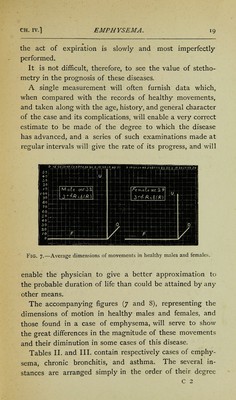
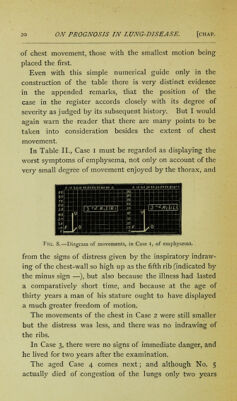
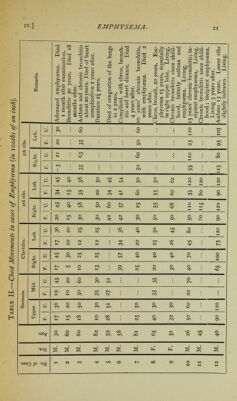
![after the examination, yet his expectation of life was really- greater on account of his age, and at the time of noting there was no heart or kidney mischief. In Case 6, both mitral and aortic valves were already seriously diseased, and hence the prognosis was necessarily hazardous ; but so far as the lungs were concerned it was evident from the degree of chest movement enjoyed, that he had still a large reserve of respiratory power to fall back upon. Case 7 was also far advanced in life, but the com- parative freedom'of the chest movements showed that his disease had notj as yet seriously affected him. He lived in fact two years after the examination. Cases 8, 9, 10, 11, and 12 are all still living, and having already spent so many years in coughing, with so little impairment of chest movement, they are obviously the most hopeful of the group. It may be] objected, that these cases are too few in number to justifiy the erection upon them of a theory of prognosis. I believe, however, that they are fairly representative in their character,1 and when we consider the mode in which emphysema is known to advance and to affect the movable parts of the thorax, we may venture to take the chest record provisionally, if not absolutely, as a very useful guide to our opinion respecting the degree to which the disease has advanced, and consequently as to its rate of progress towards a fatal termination. 1 In order to avoid any suspicion of bias on my own part in their selection, I simply took the first dozen cases of which I had complete notes, and of which I knew the termination or the result.](https://iiif.wellcomecollection.org/image/b2100710x_0040.jp2/full/800%2C/0/default.jpg)

 No text description is available for this image
 No text description is available for this image
 No text description is available for this image