Volume 1
Catalogue of the Stowe manuscripts in the British Museum.
- British Museum. Department of Manuscripts (Stowe MSS)
- Date:
- 1895-1896
Licence: Public Domain Mark
Credit: Catalogue of the Stowe manuscripts in the British Museum. Source: Wellcome Collection.
23/850 page 3
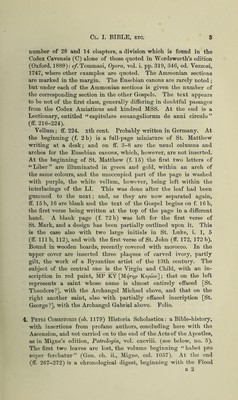
![number of 28 and 14 chapters, a division which is found in the Codex Cavensis (C) alone of those quoted in Wordsworth’s edition (Oxford, 1889): c/. Tommasi, Opera, vol. i. pp. 319, 346, ed. Vezzosi, 1747, where other examples are quoted. The Ammonian sections are marked in the margin. The Eusebian canons are rarely noted; but under each of the Ammonian sections is given the number of the corresponding section in the other Gospels. The text appears to be not of the first class, generally differing in doubtful passages from the Codex Amiatinus and kindred MSS. At the end is a Lectionary, entitled “capitulare euuangeliorum de anni circulo” (ff. 216-224). Vellum; ff. 224. xth cent. Probably written in Germany. At the beginning (f. 2 b) is a full-page miniature of St. Matthew writing at a desk; and on ff. 3-8 are the usual columns and arches for the Eusebian canons, which, however, are not inserted. At the beginning of St. Matthew (f. 16) the first two letters of “ Liber ” are illuminated in green and gold, within an arch of the same colours, and the unoccupied part of the page is washed with purple, the white vellum, however, being left within the interlacings of the LI. This was done after the leaf had been gummed to the next; and, as they are now separated again, ff. 15 b, 16 are blank and the text of the Gospel begins on f. 16 b, the first verse being written at the top of the page in a different hand. A blank page (f. 72 b) was left for the first verse of St. Mark, and a design has been partially outlined upon it. This is the case also with two large initials in St. Luke, i. 1, 5 (ff. Ill b, 112), and with the first verse of St. John (ff. 172, 172 b). Bound in wooden boards, recently covered with morocco. In the upper cover are inserted three plaques of carved ivory, partly gilt, the work of a Byzantine artist of the 13th century. The subject of the central one is the Virgin and Child, with an in- scription in red paint, MP KY [Mrjrr^p Kupiou]; that on the left represents a saint whose name is almost entirely effaced [St. Theodore?], with the Archangel Michael above, and that on the right another saint, also with partially effaced inscription [St. George?], with the Archangel Gabriel above. Folio. 4. Petri CoMESTORis (o6. 1179) Historia Scholastica; a Bible-history, with insertions from profane authors, concluding here with the Ascension, and not carried on to the end of the Acts of the Apostles, as in Migne’s edition, Patrologia, vol. cxcviii. (see below, no. 5). The first two leaves are lost, the volume beginning “ habet pro super ferebatur ” (Gen. ch. ii., Migne, col. 1057). At the end (ff. 267-272) is a chronological digest, beginning with the Flood B 2](https://iiif.wellcomecollection.org/image/b29002618_0001_0023.jp2/full/800%2C/0/default.jpg)




 No text description is available for this image
 No text description is available for this image
 No text description is available for this image