A complete handbook of treatment : arranged as an alphabetical index of diseases to facilitate reference, and containing nearly one thousand formulae / by William Aitken.
- William Aitken
- Date:
- 1882
Licence: Public Domain Mark
Credit: A complete handbook of treatment : arranged as an alphabetical index of diseases to facilitate reference, and containing nearly one thousand formulae / by William Aitken. Source: Wellcome Collection.
Provider: This material has been provided by the Francis A. Countway Library of Medicine, through the Medical Heritage Library. The original may be consulted at the Francis A. Countway Library of Medicine, Harvard Medical School.
322/456 page 316
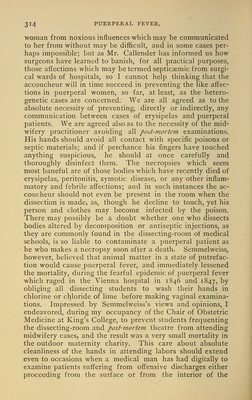
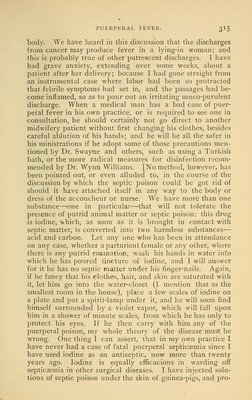
![duced death by septicaemia. I have also injected some of the same solutions, into which I had dropped a few drops of the tincture of iodine, without producing any ill effects. It is needless to observe that the prevention and the cure of this disease go hand in hand together. Should any septic poison be present in the puerperal woman, wash her out again and again with solution of iodine until the solution comes back the same color as it was thrown up. The tem- perature of the patient will probably be 103'^ or 104°, and it will go down in a very short time to 98°. This I have witnessed since the present discussion began, (Dr. Wynn Williams.)] *' Many chemical substances have been recommended to be added to water for purifying the hands; iodine, chlorine and its compounds, sulphurous acid, cyanide of potassium, carbolic acid, and the permanganates. It matters not which agent is employed, so long as it is used carefully and effici- ently; and if it be necessary to disinfect clothing, this is readily done by exposing it in an oven to a high temperature, for which many upholsterers have a suitable arrangement. With all deference to Dr. Matthews Duncan, I have no doubt that every medical practitioner who earnestly desires to pro- mote the welfare of his patients and to keep himself blameless, should at once abstain from attending fresh cases of labor when one or more of those recently delivered by him have died with acute febrile symptoms, or are still so ill as to re- quire his constant visits. When, indeed, there is the remo- test suspicion that he may convey the poison in his own per- son, he should not incur the risk of disseminating it. How long he ought to absent himself from midwifery practice, is yet a moot point. Dr. Swayne thinks a medical man should seclude himself for a week only; others think a month hardly sufficient. The remarkable experience of Dr. Huntly, of Yarrow-on-Tyne {Brit. Med. Journ., Feb. 27, 1875, p. 271), led him to believe that he actually generated poison . in his own body, as the result of some faulty process, which he communicated to his patients. Taking all the circum- stances into consideration, I am disposed to recommend a week's seclusion after regular attendance has ceased on a sin- gle puerperal fever case. When a series of cases have occurred in the practice of any one medical man, he should absent himself from midwifery practice for a month at least. Dur- ing either the short or long interval of seclusion, the means for disinfection should be fully carried out.](https://iiif.wellcomecollection.org/image/b21038247_0322.jp2/full/800%2C/0/default.jpg)



 No text description is available for this image
 No text description is available for this image
 No text description is available for this image