Infant mortality in Scotland / the report of a sub-committee of the Scientific Advisory Committee.
- Great Britain. Department of Health for Scotland. Scientific Advisory Committee on Medical Administration and Investigation.
- Date:
- 1943
Licence: Public Domain Mark
Credit: Infant mortality in Scotland / the report of a sub-committee of the Scientific Advisory Committee. Source: Wellcome Collection.
33/88 page 31
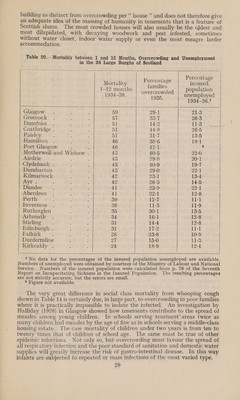
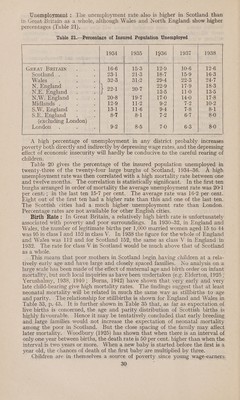
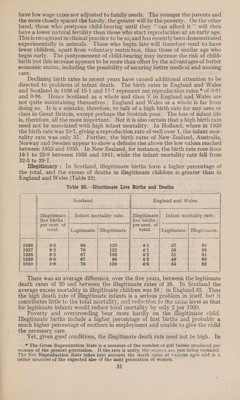
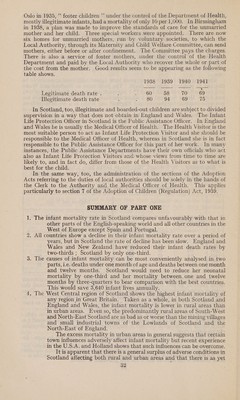
![have low wage rates not adjusted to family needs. The younger the parents and the more closely spaced the family, the greater will be the poverty. On the other hand, those who postpone child-bearing until they “can afford it ’’ will then have a lower natural fertility than those who start reproduction at an early age. This is recognised in clinical practice to be so, and has recently been demonstrated experimentally in animals. Those who begin late will therefore tend to have fewer children, apart from voluntary restriction, than those of similar age who begin early. The postponement of child-bearing may increase the risk of child- birth but this increase appears to be more than offset by the advantages of better economic status, including the possibility of securing better medical and nursing care. | Declining birth rates in recent years have caused additional attention to be directed to problems of infant death. The birth rates in England and Wales and Scotland in 1938 of 15-1 and 17-7 represent net reproduction rates * of 0-81 and 0-96. Hence Scotland as a whole and class V in England and Wales are not quite maintaining themselves ; England and Wales as a whole is far from doing so. It is a mistake, therefore, to talk of a high birth rate for any area or class in Great Britain, except perhaps the Scottish poor. The loss of infant life is, therefore, all the more important. But it is also certain that a high birth rate need not be associated with high infant mortality. In Holland, where in 1938 the birth rate was 20-7, giving a reproduction rate of well over 1, the infant mor- tality rate was only 37. Further, the birth rates of New Zealand, Australia, Norway and Sweden appear to show a definite rise above the low values reached between 1933 and 1935. In New Zealand, for instance, the birth rate rose from 16-1 to 22-8 between 1935 and 1941, while the infant mortality rate fell from 32-3 to 29-7. | illegitimacy : In Scotland, illegitimate births form a higher percentage of the total, and the excess of deaths in illegitimate children is greater than in England and Wales (Table 22). Table 22.—Illegitimate Live Births and Deaths Scotland. England and Wales. Illegitimate Infant mortality rate. Illegitimate; Infant mortality rate. || live births : live births: Per Cenc, OL (ot nr ore er DOEMCC DL. OL |” total. Legitimate. | Illegitimate. total. Legitimate. | Illegitimate. 1936 6:5 80 120 4°] 57 88 1937 6°2 78 122 4°] 56. 88 1938 6°2 67 109 4°2 51 81 | 1939 6°0 67 96 4°2 49 90 1940 5:9 76 120 43 55 82 } There was an average difference, over the five years, between, the legitimate death rates of 20 and between the illegitimate rates of 26. In Scotland the average excess mortality in illegitimate children was 38 ; in England 32. Thus the high death rate of illegitimate infants is a serious problem in itself, but it contributes little to the total mortality, and reduction to the same level as that for legitimate infants would reduce total mortality by only 2 per 1000. Poverty and overcrowding bear more hardly on the illegitimate child. Illegitimate births include a higher percentage of first births and probably a much higher percentage of mothers in employment and unable to give the child the necessary care. Yet, given good conditions, the illegitimate death rate need not be high. In * The Gross Reproduction Rate is a measure of the numberof girl babies produced per woman of the present generation. If the rate is unity, the women are just being replaced. The Net Reproduction Rate takes into account the death rates at various ages and is a better measure of the expected size of the next generation of women.](https://iiif.wellcomecollection.org/image/b32174640_0033.jp2/full/800%2C/0/default.jpg)