Annual report of the Commissioner of Public Health to 30th June, 1934 / Queensland.
- Queensland. Department of Public Health
- Date:
- 1934
Licence: Public Domain Mark
Credit: Annual report of the Commissioner of Public Health to 30th June, 1934 / Queensland. Source: Wellcome Collection.
12/38 (page 10)
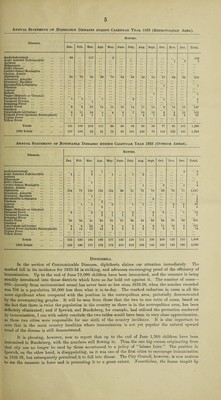
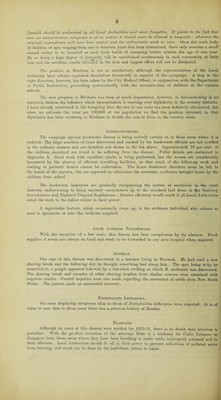
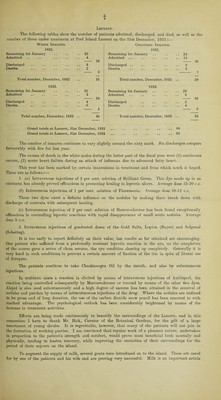
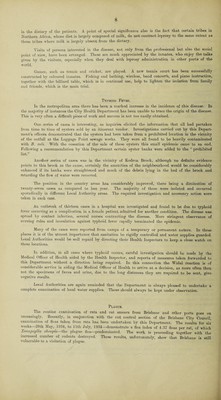
![. The disease broke out again in June, when five cases were reported. The season was again very wet for the time of the year. The disease was confined to male canecutlters of the Ingham district. The Medical Officer in Charge of the Commonwealth Institute, Townsville, proceeded immediately to Ingham and inoculated guinea pigs with blood and urine taken from the patients, but without result. [At the moment of going- to press it is reported that the Leptospira icterohcemorrhagice. has been isolated from rats and patients. The diagnosis of Weil’s disea,se is definitely established. This being the first recorded instance of Weil’s, disease in Australia,, much credit is due to Doctors G. C1. Morrissey and T. Leckie for having clinically diagnosed the disease, and to Dr. J. T. Cotter, of the Commonwealth Institute, Townsville, for having isolated the causative organism and proved, the correctness of their diagnosis. Rats abound in the district. A full report, when all details are finalised, will be published at a later date.] Epidemics of this nature should act a,s warnings that it is dangerous to allow health services to languish. A health organisation to be successful must never, be allowed to become static, as, immediately it does, itl is doomed to failure. It must also be remembered that the first duty of the public health service is prevention of disease, not the spectacular crushing of epidemics. Therefore, if such a principle of success is to be attained, properly-trained Health Officers must be maintained, and adequately supported. (Local Authorities are again informed that Weil’s disease, coastal fever, Mossman .fever, and Sarina fever have been madia notifiable under the Health Acts for the whole of the State. Venereal Diseases. (Health Acts, 1900-1931.) Report for the Twelve Months ending 30th June, 193^. The term “ Venereal Disease ” includes gonorrhoea, ophthalmia neonatorum (gonorrhoeal), syphilis (all stages), soft chancre, ulcerative granuloma, and venereal warts. Notifications. During the twelve months under review 1,576 persons were notified (anonymously) as suffering from venereal disease,—as compared with 1,464 for the previous twelve months. As some of these patients had more than one venereal disease, this number represented 1,606 cases of venereal disease- as compared with 1,513 cases during 1932-33. It is gratifying to note that many practitioners are acceding to my request that the' exact stage and type of the disease be stated on the notification form'. Onei purpose of notification is to enable Public Health Officers to determine the trend of the incidence of disease from year to year, and with a disease such as syphilis, with its varied phases and protean manifestations, no true idea can be obtained unless this be done. Syphilis.—Three hundred and sixty-six of these cases were syphilitic as compared with 374 in 1932-33. Unfortunately, 74 of these cases represent the first and second stages as compared with 64 in 1932-33, and this would suggest an increase in the incidence of fresh infections with syphilis. However, until the figures for unspecified syphilis are investigated more fully, such a deduction may be premature. It is hoped that as this portion of the Department’s activities become better co-ordinated and supervised these unspecified cases will become properly classified. Gonorrhoea.-—One thousand two hundred and sixteen of the cases were for the various gonorr¬ hoeal infections (excluding ophthalmia), as compared with 1,118 for 1932-33. An arresting fact in these figures is the 71 cases of female children of pre-pubertal age infected with gonorrhoea—surely eloquent proof and warning of the infectiousness of gonorrhoea, apart from sexual relations. Other Forms of Venereal Disease.-—These account for the balance of the cases headed by 11 cases of ulcerative granuloma In a country so largely tropical as Queensland one would like to see these cases more fully investigated. The term “ ulcerative granuloma ” may include granulotma inguinale, lympho-granuloma inguinale, or any other condition giving rise to chronic ulcerations about the pudenda. Another interesting point in connection with these tropical and sub-tropical cases isi that there is little definite information regarding yaws in tropical Queensland. In view of the fact that Professor Blacklock has brought forward fresh evidence that, yaws may be merely tropical syphilis as seen in persons of uncleanly and unhygienic habits, it would be of definite interest and value to- determine the extent (if any) of yaws in North Queensland.](https://iiif.wellcomecollection.org/image/b3182951x_0012.jp2/full/800%2C/0/default.jpg)