Vitamin D in ergot of rye / by Edward Mellanby, Ella Surie, and Douglas Creese Harrison.
- Edward Mellanby
- Date:
- [1929?]
Licence: In copyright
Credit: Vitamin D in ergot of rye / by Edward Mellanby, Ella Surie, and Douglas Creese Harrison. Source: Wellcome Collection.
1/10
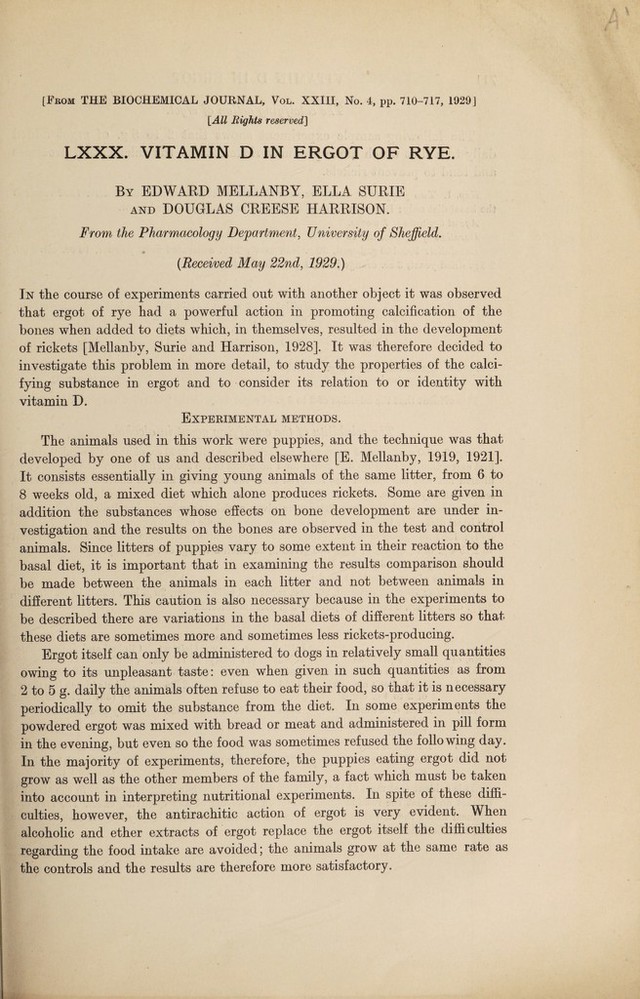
![[All Rights reserved] LXXX. VITAMIN D IN ERGOT OF RYE. By EDWARD MELLANBY, ELLA SURIE and DOUGLAS CREESE HARRISON. From the Pharmacology Department, University of Sheffield. (Received May 22nd, 1929.) In the course of experiments carried out with another object it was observed that ergot of rye had a powerful action in promoting calcification of the bones when added to diets which, in themselves, resulted in the development of rickets [Mellanbv, Surie and Harrison, 1928]. It was therefore decided to investigate this problem in more detail, to study the properties of the calci¬ fying substance in ergot and to consider its relation to or identity with vitamin D. Experimental methods. The animals used in this work were puppies, and the technique was that developed by one of us and described elsewhere [E. Mellanby, 1919, 1921]. It consists essentially in giving young animals of the same litter, from 6 to 8 weeks old, a mixed diet which alone produces rickets. Some are given in addition the substances whose effects on bone development are under in¬ vestigation and the results on the bones are observed in the test and control animals. Since litters of puppies vary to some extent in their reaction to the basal diet, it is important that in examining the results comparison should be made between the animals in each litter and not between animals in different litters. This caution is also necessary because in the experiments to be described there are variations in the basal diets of different litters so that these diets are sometimes more and sometimes less rickets-producing. Ergot itself can only be administered to dogs in relatively small quantities owing to its unpleasant taste: even when given in such quantities as from 2 to 5 g. daily the animals often refuse to eat their food, so that it is necessary periodically to omit the substance from the diet. In some experiments the powdered ergot was mixed with bread or meat and administered in pill form in the evening, but even so the food was sometimes refused the following day. In the majority of experiments, therefore, the puppies eating ergot did not grow as well as the other members of the family, a fact which must be taken into account in interpreting nutritional experiments. In spite of these diffi¬ culties, however, the antirachitic action of ergot is very evident. When alcoholic and ether extracts of ergot replace the ergot itself the difficulties regarding the food intake are avoided; the animals grow at the same rate as the controls and the results are therefore more satisfactory.](https://iiif.wellcomecollection.org/image/b30627904_0001.jp2/full/800%2C/0/default.jpg)