A text-book of physiology : for medical students and physicians / by William H. Howell.
- William Henry Howell
- Date:
- 1907
Licence: Public Domain Mark
Credit: A text-book of physiology : for medical students and physicians / by William H. Howell. Source: Wellcome Collection.
Provider: This material has been provided by the Augustus C. Long Health Sciences Library at Columbia University and Columbia University Libraries/Information Services, through the Medical Heritage Library. The original may be consulted at the the Augustus C. Long Health Sciences Library at Columbia University and Columbia University.
42/1044 page 34
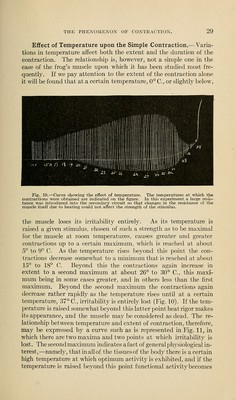
![it is usually permanent, that is to say, it wears off only as the muscle relaxes slowly from fatigue. Toward the end of such a series the muscle is often practically in a state of continuous contraction, a condition which would nullify its ordinary use in locomotion. It seems possible that certain conditions of tonic spasm or cramps which occur during life may involve this process, for example, the temporary cram]) that sometimes attacks a player in athletic games, or the curious spasmodic condition known as intermittent claudication, in which, apparently as a result of insufficient circulation, the muscles on exercise are thrown into a state of tonic contraction. From the physiological standpoint the phenomenon of contracture when compared with that of the simple contraction indicates the possibility that two different contraction processes may take place in muscle, one involving the state of tone and. therefore, the length and hardness of the muscle, the other con- trolling the movements proper. This suggestion has been made by a number of authors* on various grounds, and is of interest as indicating a point of view different from that usually held in regard to muscular contraction. The Effect of Rapidly Repeated Contractions.—When a muscle is stimulated repeatedly by stimuli of equal strength that fall into the muscle at equal intervals the contractions show certain features that, in a general way, are constant, although the precise degree in'which they are exhibited varies curiously in different animals. Such curves are exhibited in Figs. 14, 15, and 16, and the features worthy of note may be specified briefly as .follows: 1. The Introductory Contractions.—The first three or four con- tractions decrease slightly in extent, showing that the muscle at first loses a little in irritability on account of previous contractions. This phenomenon is frequently absent. 2. The Staircase or Treppe.—After the first slight fall in height has passed off the contractions increase in extent with great regularity and often for a surprisingly large number of contractions. This gradual increase in extent of shortening, with a constant stimulus, was first noticed by Bowditch upon the heart muscle, and was by him named the phenomenon of treppe, the German word for staircase. It indicates that the effect of activity is in the beginning beneficial to the muscle in that its irritability steadily increases, and the fact that the same result has been ob- tained from heart muscle, plain muscle, and nerve fibers indicates that it may be a general physiological law that functional activity leads at first to a heightened irritability. According to Lee,f the treppe in muscle is due to an initial augmenting effect of the chemical products formed during contraction. .'). ('onIntel lire. This phenomenon of maintained contraction Ij.i- been described above. In frog's muscles Stimulated repeat- edly it makes its appearance, as a rule, sooner or Later in llie Series of contractions; but there is a curious amount of variation in the muscles of different individuals in this respect. • See especially [Texkull, Zentralblatl f. Physiologie, L908, 22, 33; also Guenther, American Journal of Physiology, L905, L4, 7.'!. t Bee American Journal of Physiology, 1907, L8, 267.](https://iiif.wellcomecollection.org/image/b21218183_0042.jp2/full/800%2C/0/default.jpg)